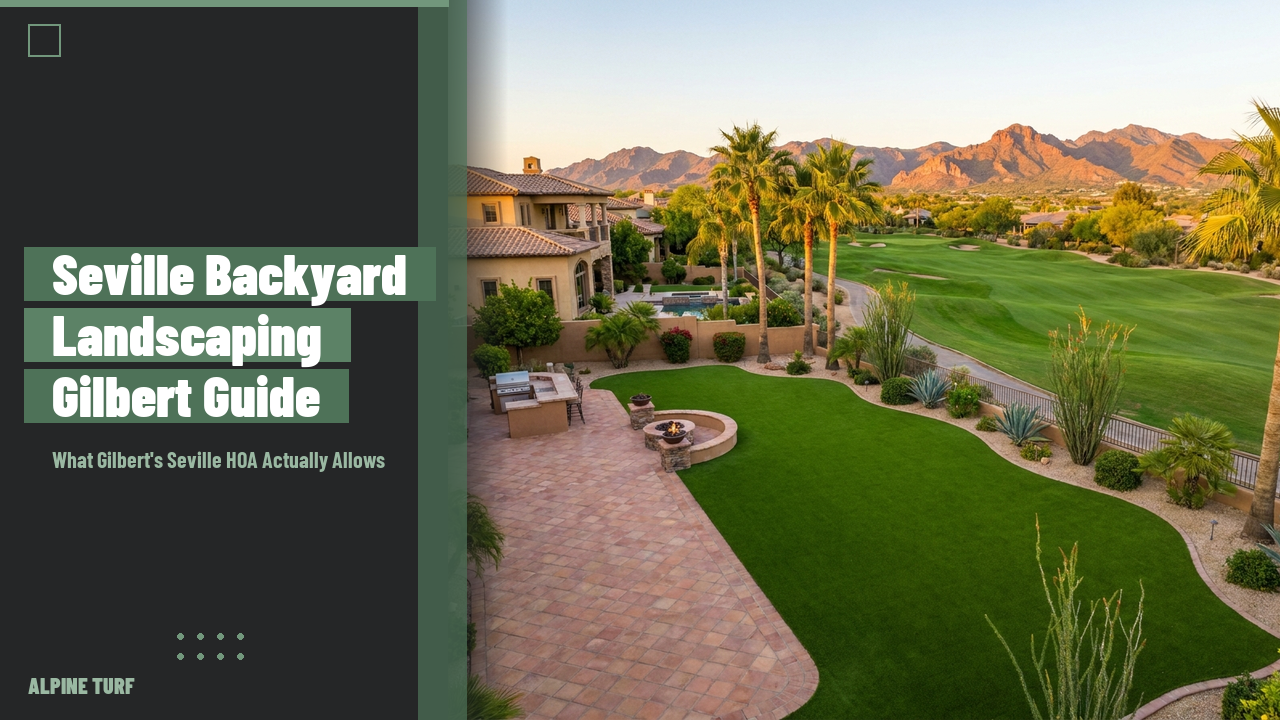
Seville Backyard Install Gilbert Guide: What the ARC Actually Allows
A Seville backyard install in Gilbert has to clear Architectural Review before you break ground, and the community doesn't publish its guidelines online. Here's what actually governs turf, pavers, and golf-course lots, plus real cost ranges.
A Seville backyard install in Gilbert starts differently than it does almost anywhere else in the East Valley: there's no public PDF to read first. Communities like Power Ranch and Eastmark post their design guidelines online. Seville doesn't. We found out the hard way years ago, sending a homeowner's plan in based on a generic Gilbert HOA template, only to have it bounced because Seville's Architectural Review Committee (ARC) wanted a plot plan and material samples we hadn't included.
Seville Golf and Country Club is a Tuscan-themed master-planned community built out in phases from the late 1990s through 2019, home to Gilbert's only private golf course, and lot sizes here vary more than almost any other East Valley community — from attached patio homes to custom estates over 10,000 sq ft backing directly to the fairway. That range means a Seville backyard install can look like a $15,000 turf-and-paver refresh or a $100,000 custom outdoor living build, and the ARC review looks different depending on which one you're doing. This post covers what actually governs a backyard project here, what it costs, and how we handle the review process for every Seville install we run.
Seville backyard install Gilbert homeowners need ARC approval for first
Like every master-planned HOA in Gilbert, Seville requires Architectural Review Committee sign-off before any exterior landscape or hardscape change, turf swaps included. What's different about Seville is that the current Design Guidelines aren't published on a public-facing page the way Power Ranch's are. The community's resident portal points homeowners to the HOA's management office for ARC forms and the current guideline document rather than hosting it for download.
In practice, that means three things for a Seville project:
- You can't self-serve the guidelines the night before a submittal the way you can in most East Valley HOAs — you (or your installer) need to request the current document directly.
- Guidelines get revised without a public changelog, so a copy a neighbor gave you two years ago isn't a safe reference for your submittal today.
- Turnaround depends on how complete your first packet is; incomplete submittals go back into the queue rather than getting a quick follow-up email.
We pull the current Seville Design Guidelines directly from the HOA's management office before we draw up a plan, specifically so the plot plan, material specs, and setback dimensions we submit match what the ARC is reviewing against this year. It's the single biggest time-saver we offer Seville homeowners over a DIY submittal.
Turf and ground cover: what holds up under ARC review
Every Gilbert HOA we work in draws a hard line on ground cover material and turf quality, and Seville is no exception in spirit even though the exact spec sheet isn't public. The baseline that holds across every East Valley golf-community HOA we've submitted to:
- Ground cover: decomposed granite in an approved, blended color is the default expectation for anything visible from the street or a neighboring lot. Loose native rock and matched decorative rock are typically fine in rear yards that don't back to common area or the course; front yards get more scrutiny.
- Artificial turf: professional-grade synthetic turf (we install 60–80 oz. product depending on the area) with a defined hardscape or granite border reads as intentional to a review committee, where a turf patch dropped straight into gravel usually doesn't. Arizona's HB2131 (2022) guarantees your right to install artificial turf even where an HOA permits natural grass, capped at 70% of total lot coverage across front, side, and rear combined — the ARC can still regulate grade, color, and maintenance standards, just not ban it outright.
- Golf-course-facing lots: anything visible from the fairway or cart path typically gets extra scrutiny on color and screening, since it's part of the view corridor other residents and golfers see daily.
We keep photos of turf and hardscape submittals that have cleared Seville's ARC recently on file, which helps us match colors and grades the committee has already approved rather than guessing.
Golf-course-facing lots: fencing, screening, and errant balls
Seville's fairway-adjacent lots come with considerations most East Valley backyards never deal with. View fencing along a golf-course lot line is usually wrought iron or tubular steel rather than block, specifically so the sightline to the course stays open — that's a design decision worth confirming with the ARC before you finalize a hardscape plan that assumes a solid wall. Pool equipment, spa equipment, and utility boxes on a course-facing lot typically need to be screened from both the course and neighboring yards, which we plan into the layout rather than bolting on afterward.
Errant golf balls are also a real, if unglamorous, design input. Homeowners on active fairway lots often ask us to angle seating areas and fire features away from the most common ball paths, and to specify impact-resistant glass or screening on pergola panels facing the course. None of this is an ARC requirement as far as we've found — it's just what experienced golf-community homeowners ask for once they've lived through a season.
Real cost of a Seville backyard install
Because Seville spans everything from attached patio homes to golf-course estates, cost ranges here are wider than a typical Gilbert cost guide. Here's what we typically see, all-in with labor, base prep, and materials:
- Turf-only refresh (existing hardscape, replacing dead grass or old turf): $5,000–$15,000 depending on square footage.
- Turf + paver patio + basic plant package: $15,000–$40,000, the most common scope on standard Seville lots.
- Full build-out (turf, extended pavers, pergola or ramada, irrigation, lighting): $40,000–$65,000, common on the larger interior lots.
- Custom outdoor living (pool decking, outdoor kitchen, water feature): $65,000–$120,000+, most common on the golf-course-facing estate lots in sections like Estados at Seville.
These track closely with our Gilbert backyard cost guide, with one Seville-specific line item: budget an extra $500–$1,200 if you want us to handle the ARC document pull and submittal packet rather than sourcing the current guidelines and drawing the plot plan yourself.
Ramadas, pergolas, and outdoor kitchens
Shade structures and built-in kitchens are where most East Valley HOA submittals get bounced, almost always over setbacks and height rather than the concept itself. Without Seville's specific published numbers to cite, the safe planning baseline we use across comparable Gilbert golf-community HOAs is a minimum 5 ft setback from any wall or fence for a pergola, 10 ft from the main structure for a freestanding ramada, and a height cap in the 10–12 ft range — and we confirm the exact figures against Seville's current guidelines before finalizing a design rather than assuming they match a neighboring community.
Built-in barbecue islands, fire pits, and outdoor fireplaces generally need to sit inside the rear yard rather than a side yard visible from the street, and any chimney or vertical element usually draws a height review if it's near a view fence or golf-course sightline. Portable fire features are typically the path of least resistance if you want flexibility without an extra submittal.
Drainage, clay soil, and monsoon prep in Seville
Seville sits on the same heavy clay and caliche mix that causes standing water across Gilbert after a monsoon cell, and lot grading here can't redirect water toward a neighbor, the golf course, or common area — that's a standard expectation across every HOA we work in, not unique to Seville, but it's worth stating plainly because it's the single most common reason a backyard floods a season after installation.
What actually works: a compacted crushed-granite base under turf and pavers instead of sand, which settles and creates low spots within a year or two; a slight positive grade away from the home; and drainage swales that move water to a catch basin or the street rather than letting it pool against a block wall or view fence. For a deeper look at how clay soil behaves under East Valley installs, see our monsoon-proof backyard guide for Gilbert and our caliche soil landscaping breakdown.
Getting your Seville ARC submittal approved the first time
A submittal that clears on the first pass includes a plot plan with dimensions for everything you're adding, material samples or spec sheets for turf and hardscape, and color selections for anything visible from a neighboring lot, common area, or the course. If a ramada, pergola, or built-in kitchen is part of the scope, dimension the setbacks directly on the drawing rather than describing them in a cover letter.
We handle the full ARC packet as part of every Seville backyard install: pulling the current guidelines from the HOA's management office, drawing the plot plan, matching granite color and turf grade to what's recently cleared review, and dimensioning setbacks for any structure. Homeowners who submit on their own most often lose time simply locating the current guideline document, which is the one step we remove entirely.
Frequently asked questions
Does Seville's HOA allow artificial turf in the backyard?
Yes, with ARC review on grade, color, and placement. Arizona's HB2131 (2022) prevents any HOA that allows natural grass from banning artificial turf outright, up to 70% of total lot coverage. Seville's Architectural Review Committee can still set standards for how it looks and how it's installed, which is why we submit a material spec sheet with every turf project here.
Where do I get Seville's current Design Guidelines?
Seville doesn't publish its Design Guidelines on a public download page the way some Gilbert HOAs do. Residents request the current document through the community's HOA management office. We pull it directly as part of every quote so the submittal we draw up matches what the ARC is actually reviewing against this year.
What's different about landscaping a golf-course-facing lot in Seville?
Course-facing lots typically use open view fencing (wrought iron or tubular steel) instead of solid block, so pool equipment, spas, and utility boxes need to be screened from both the fairway and neighboring yards. Many homeowners also angle seating and fire features away from common ball paths, and consider impact-resistant screening on pergola panels facing the course.
How long does ARC approval take in Seville?
Plan on a few weeks for a complete submittal. The most common delay isn't the review itself, it's homeowners locating the current guideline document before they can even draw a compliant plan. A plot plan with dimensions, material specs, and color selections up front is the fastest path through.
How much does a Seville backyard install cost?
Most standard Seville lots land between $15,000 and $40,000 for turf, a paver patio, and a basic plant package. A turf-only refresh starts around $5,000. Larger golf-course-facing estate lots with pool decking, outdoor kitchens, or water features typically run $65,000 to $120,000 or more.
Can I build a pergola or ramada on my Seville lot?
Generally yes, with ARC approval and setback dimensions on the drawing. We use a minimum 5 ft wall setback for pergolas and 10 ft from the main structure for freestanding ramadas as our planning baseline across comparable Gilbert golf-community HOAs, then confirm the exact figures against Seville's current guidelines before finalizing the design.
Ready for your Seville backyard install?
We handle Seville ARC-compliant installs across turf, pavers, plants, and irrigation, including pulling the current guidelines and drawing the submittal packet. Free on-site measure and quote, no obligation.
Book your free quote →