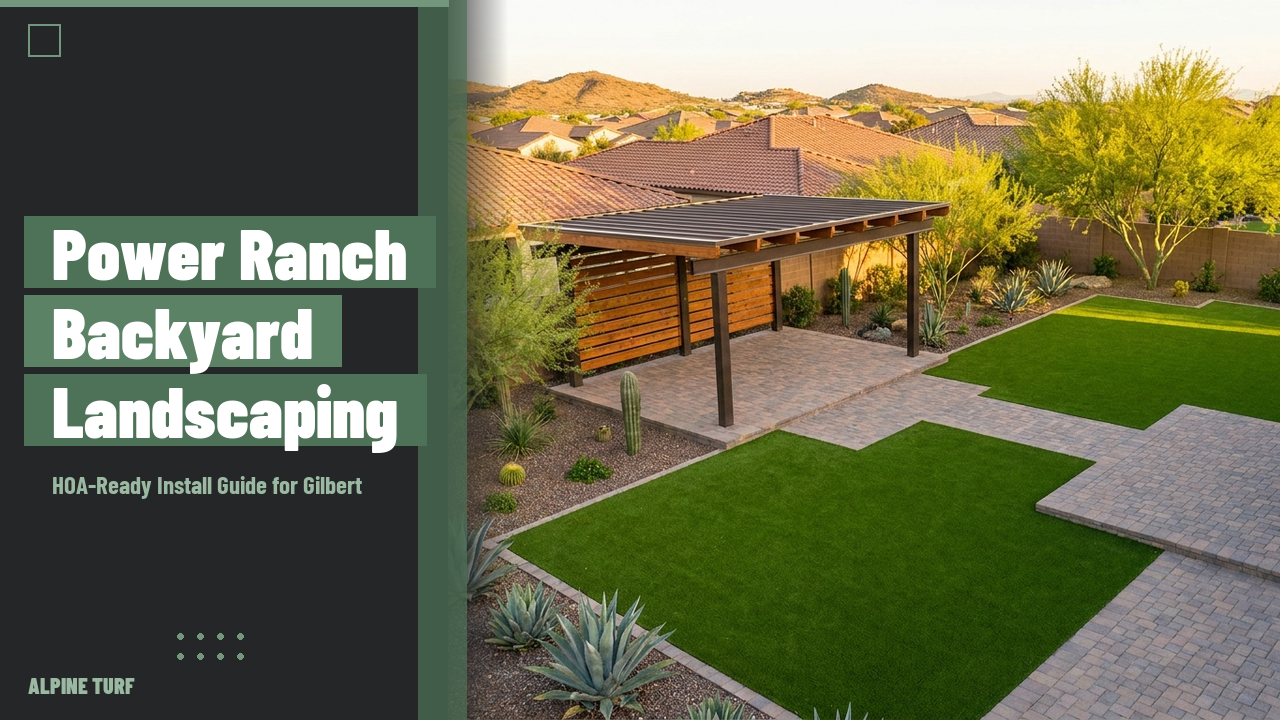
Power Ranch Backyard Landscaping: What Gilbert's HOA Actually Allows
Power Ranch's Design Review Committee will send your plans back if you guess. Here's what the actual guidelines require for turf, pavers, ramadas, and drainage, plus real cost ranges for a full Power Ranch backyard.
Power Ranch is one of the East Valley's most tightly governed HOA communities, and that shows the moment you try to landscape a backyard here. We've had homeowners call us after a Design Review Committee rejection on something as simple as gravel color, weeks lost redoing a submittal that should have been right the first time. The guidelines aren't secret, but they're buried in a 17-page PDF most people never read until their plans bounce back.
We install full backyards across Power Ranch, from turf refreshes to complete paver-and-pergola builds, and we pull permits and submittals against these guidelines every month. This post walks through what the Design Review Committee actually requires, what it typically costs to landscape a Power Ranch backyard the right way, and how to get your plan approved without a second round trip.
Power Ranch backyard landscaping rules: what the DRC requires
Power Ranch Community Association's Design Guidelines are explicit on one point: no work begins without Design Review Committee (DRC) approval, and that includes turf, hardscape, and most standalone structures. Meeting the letter of the guidelines doesn't exempt you from submitting; the document states plainly that even a change identical to one already approved elsewhere in the community still has to go through the process.
A few rules apply across the whole property and catch new backyard projects off guard:
- Additions and hardscape must stay within the setback lines originally established for Power Ranch, even where the Town of Gilbert would allow something closer to the property line.
- Lot drainage can't be altered by a landscaping project. Water has to stay on your own deeded lot; it can't be redirected toward the foundation, a neighbor's yard, or common area.
- Any additional municipal permits (Gilbert requires one for sheds 200 sq ft or larger, for example) are the homeowner's responsibility on top of DRC approval, not instead of it.
In practice, this means the plan you bring to us needs a plot drawing, material samples, and enough detail for the committee to sign off without follow-up questions. We build that packet as part of every Power Ranch install. If you want to read the source document yourself, the current Power Ranch Community Association Design Guidelines are posted on the community's official site.
Turf, ground cover, and plant rules you can't guess your way through
This is where most DIY submittals get bounced. Power Ranch's guidelines are specific about materials, and "close enough" isn't a category the committee accepts.
- Ground cover: only decomposed granite or native granite rock is approved. Front yards must use Apache Brown screened decomposed granite (5/8″–1″) sourced from Pioneer Landscaping, the community's original supplier. Rear yards are more flexible; the color just has to blend with the surrounding lots, and if you have a view fence, the committee wants a sample before you replace or replenish it.
- What's banned as ground cover: river rock, crushed rock, artificially colored rock, and flagstone (or anything that looks like flagstone) are all off the table — with one exception. Drainage swales specifically require angular riprap between 3″ and 5″, color pre-approved, which is the opposite rule applied to the opposite purpose. Homeowners frequently mix these up.
- Artificial turf: the guidelines call it out by name for front yards — minimum 50 oz. grade, professionally installed, kept weed-free once it's in. A hardscape border has to separate turf from graveled areas. For backyards, Arizona's HB2131 (2022) is the backstop: an HOA that allows natural grass can't ban artificial turf outright anywhere on the lot, capped at 70% total coverage across front, side, and rear combined. Power Ranch can still regulate how it looks and how it's maintained, which is exactly what the front-yard spec does.
- Plants: cactus, fruit-bearing trees, and sissoo trees are not permitted in front yards (sissoo has been banned community-wide since January 2021 due to invasive root systems). Any shrub or tree with more than 30% dead branches or leaves has to come out, and tree stumps can't be left in place.
We keep a running list of what's passed DRC review recently in Power Ranch specifically, which saves a round of back-and-forth compared to submitting a generic Gilbert landscape plan.
Real cost to landscape a Power Ranch backyard
Power Ranch lots run larger than a lot of newer East Valley master plans, which pushes project cost up compared to a starter-home backyard in, say, Eastmark. Here's what we typically see, all-in with labor, base prep, and materials:
- Turf-only refresh (existing hardscape, just replacing dead grass): $5,000–$9,000 for a typical 1,200–1,800 sq ft rear yard.
- Turf + paver patio + basic plant package: $18,000–$30,000, the most common scope we quote in Power Ranch.
- Full build-out (turf, extended paver patio, pergola or ramada, irrigation, lighting): $35,000–$45,000+, scaling up fast if you add a built-in barbecue island or fireplace.
- Custom outdoor living (pool decking, kitchen, water feature): $60,000–$100,000+, less common but not rare on the larger Power Ranch lots backing to the greenbelt.
These numbers track closely with our Gilbert backyard cost guide, with one Power Ranch-specific wrinkle: budget an extra $800–$1,500 for DRC-compliant materials and the documentation package if you're using us to handle the submittal, versus sourcing off-spec materials that risk rejection.
Ramadas, pergolas, and fire features: the setback rules that trip people up
Shade structures are the single most common DRC rejection we see in Power Ranch, almost always over setbacks rather than design. The guidelines are precise:
| Structure | Setback | Max height | Notes |
|---|---|---|---|
| Ramada / gazebo | 10 ft from main home, 5 ft from any wall or fence | 12 ft | Solid-roofed, stand-alone |
| Pergola | 5 ft from any wall or fence | 12 ft | May be affixed to the home |
| Shade sail | 5 ft from all walls and the home | 10 ft | Fabric must be neutral, single color |
| Shed | 5 ft from property line, 10 ft from main structure | 8 ft | 200+ sq ft needs a Town of Gilbert permit too |
Built-in barbecues, fire pits, and fireplaces have to stay inside the rear yard or courtyard, and any chimney element on a fireplace is capped at 7 ft tall with a 10 ft setback from a view fence panel. Portable fire pits and tower heaters just need to be stored out of sight of neighbors and common area when they're not lit. Backyard spotlights and floodlights are allowed (front-yard spotlighting isn't), but the light can't spill onto a neighbor's yard or the common area, and post lights aren't permitted anywhere on the lot.
Irrigation, pools, and water features
Power Ranch's guidelines push homeowners toward underground drip irrigation over spray systems, reserving spray for turf areas specifically. If your backyard mixes real plants with artificial turf, that means separate zones: drip for the beds, spray (or no irrigation at all) for the turf strip. It also means loose hoses left out for watering are technically a violation; the guidelines call for hoses to be stored neatly, rolled or put away, when not in use.
Pools and spas have to be in-ground; above-ground spas are considered case by case rather than approved outright. Pool equipment, above-ground spas, and any water feature have to be screened from the street and from neighboring properties and common area, and a water feature built into a pool area can't exceed the height of the party wall without written DRC approval first. If a pool or water feature is part of your project scope, plan the screening into the drawing you submit, not as an afterthought after a rejection.
Drainage, clay soil, and monsoon season in Power Ranch
Power Ranch sits on the same heavy clay and caliche mix that causes standing water across Gilbert after a monsoon cell. The guidelines require that any grading change keep water on your own lot and away from the foundation and neighboring properties, which means a landscaping project can't just regrade toward the block wall and call it solved.
What actually works here: a proper base of compacted crushed granite under turf and pavers (not just sand, which settles and creates low spots), a slight positive grade away from the house, and drainage swales lined with angular 3″–5″ riprap where water needs to move to a catch basin or the street. That riprap spec isn't optional decoration — it's the one place river rock-style material is actually required rather than banned. For a deeper look at how clay soil behaves under East Valley turf and paver installs, see our monsoon-proof backyard guide for Gilbert and our clay soil yard problems breakdown.
Getting your Power Ranch landscape plan approved the first time
A submittal that gets approved on the first pass includes a plot plan showing the location and dimensions of everything you're adding, material samples or spec sheets for turf and hardscape, and color selections for anything visible from a neighboring lot or common area. If you're adding a ramada, pergola, or shed, dimension the setbacks directly on the drawing so the committee doesn't have to ask.
We handle the DRC packet as part of every Power Ranch install: plot plan, turf and paver spec sheets, granite color match (Apache Brown for front, blend-matched for rear), and setback dimensions for any structure. Homeowners who submit on their own most often lose time on granite color and shade-structure setbacks, exactly the two areas the guidelines spell out in the most detail.
Frequently asked questions
Does Power Ranch's HOA allow artificial turf in the backyard?
Yes. The community's Design Guidelines spell out a front-yard spec (minimum 50 oz. grade, professionally installed, weed-free), and Arizona's HB2131 (2022) prevents HOAs that allow natural grass from banning artificial turf anywhere on the lot, up to 70% total coverage. In practice, Power Ranch applies similar material and maintenance standards to backyard turf as it does to the front.
What color decomposed granite does Power Ranch require?
Front yards must use Apache Brown screened decomposed granite, 5/8 inch to 1 inch, matching the community's original Pioneer Landscaping source. Rear yards have more flexibility and just need to blend with the surrounding lots, though rear yards with a view fence are treated more like a front yard and may need a sample submitted first.
How close to my wall can I build a ramada or pergola?
A ramada or gazebo needs 10 feet of clearance from the main home and 5 feet from any wall or fence, capped at 12 feet tall. A pergola only needs the 5-foot wall setback (it may attach to the home) and is also capped at 12 feet. Both require Design Review Committee approval before you start.
How long does DRC approval take in Power Ranch?
Plan on a few weeks for a complete submittal. Incomplete packets, most often missing setback dimensions or material samples, are the main cause of delay. A plot plan with dimensions, material specs, and color selections up front is the fastest path through.
How much does a full backyard landscaping project cost in Power Ranch?
Most Power Ranch homeowners land between $18,000 and $30,000 for turf, a paver patio, and a basic plant package. A turf-only refresh on existing hardscape starts around $5,000, while a full build with a pergola or ramada, extended pavers, irrigation, and lighting typically runs $35,000 to $45,000 or more.
Can I put river rock in my Power Ranch backyard?
Not as general ground cover; river rock, crushed rock, and flagstone-look materials are specifically excluded. The one exception is drainage swales, which are required to use angular riprap between 3 and 5 inches, with the color pre-approved by the committee before installation.
Ready to landscape your Power Ranch backyard?
We handle Power Ranch DRC-compliant installs across turf, pavers, plants, and irrigation, including the design submittal paperwork. Free on-site measure and quote, no obligation.
Book your free quote →