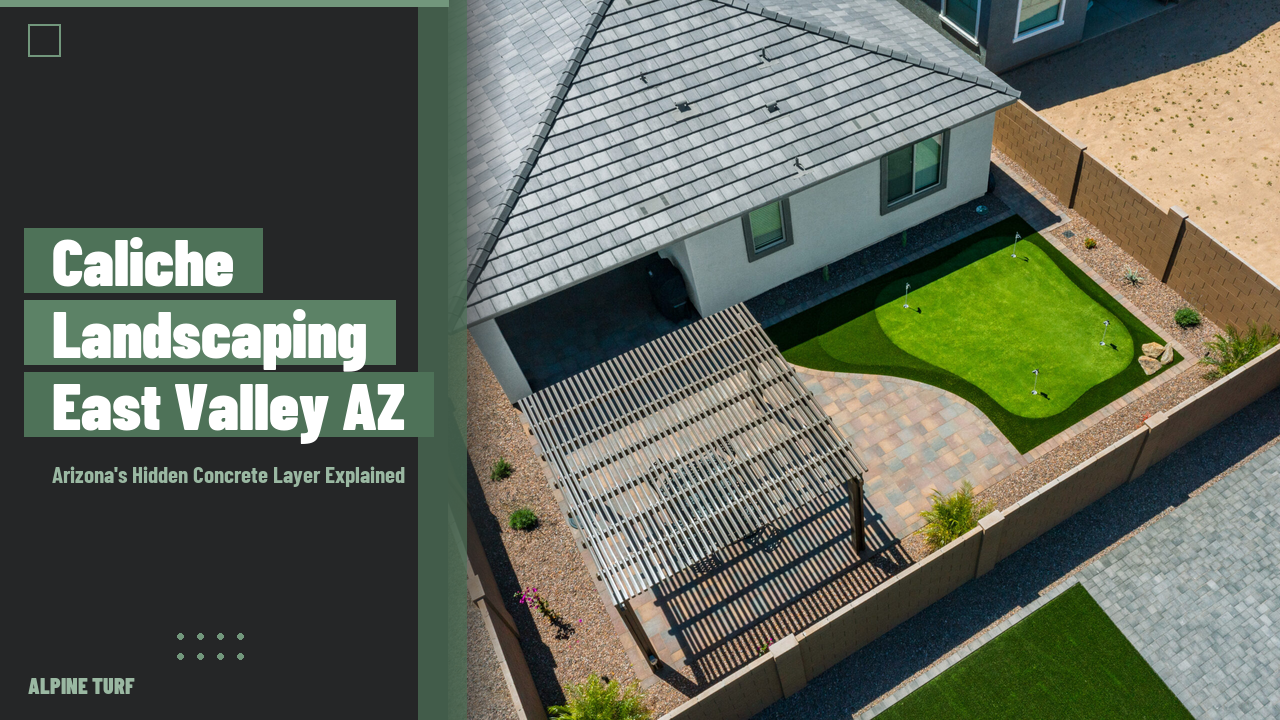
Caliche Landscaping in the East Valley AZ: A Homeowner's Playbook
Almost every East Valley yard sits on a hidden concrete-like layer of caliche, 12 to 36 inches below the surface. It is the silent reason new plants die, paver patios crack, and drainage fails three years after install. Here is how to diagnose it, what it actually costs to ignore, and how a real installer builds around it the right way.
If you have lived in the East Valley for more than a year, you have probably had at least one strange yard problem you could not explain. A tree planted by the previous owner that suddenly tipped over in a monsoon storm. A spot in the lawn where water pools every July no matter what you do. A fence post that took a half day to drive in. A paver patio that started shifting two years after the installer left. All of those have the same root cause: caliche.
This guide explains caliche landscaping in the East Valley the way we explain it on-site during free consults across Gilbert, Queen Creek, Chandler, Mesa, San Tan Valley, and Tempe. What caliche is, why your builder did not warn you about it, the four real problems it causes, how to tell if you have it without paying for a soil test, and how a real installer breaks through it during a backyard install instead of ignoring it.
What caliche actually is
Caliche is a cement-like crust of calcium carbonate that sits a few inches to a few feet below the surface in most desert Southwest soils. It is the same chemical as limestone, formed over tens of thousands of years as water carried calcium downward through the dirt and then evaporated, leaving the calcium behind to bond the soil particles together. The University of Arizona Cooperative Extension has documented the science in detail; this guide focuses on the practical install side.
In the East Valley specifically, caliche typically starts 12 to 36 inches below the surface and can be anywhere from an inch thick to multiple feet thick. Some yards have a thin caliche layer you can break through with a strong shovel. Others have caliche so dense and so thick that you literally need a jackhammer or a hydraulic auger to get through it.
Caliche is not loose dirt that compacts over time. It is bonded. It does not soften when wet, and it does not move when pushed. The closest analogy most homeowners understand: think of a concrete slab that someone poured under your yard before the topsoil went on. That is functionally what you are working with when you have caliche.
Why your builder never told you about caliche
National production builders (Lennar, KB, Taylor Morrison, Ashton Woods, William Ryan, Meritage, DR Horton, and others active across the East Valley) do not run soil surveys on individual lots before construction. Their grading crews encounter caliche as they dig foundation footings, but they only deal with it where the foundation goes. The rest of the yard stays exactly as the caliche left it, just covered by a few inches of topsoil.
Builders also have no incentive to disclose where caliche is. They are not installing your backyard. They install the slab patio, drop two hose bibs, frame in a perimeter wall, and walk away. The first time a new homeowner finds out about caliche is usually when something fails: a tree dies in year two, a fence post will not seat, a patio cracks, or an irrigation trench takes twice as long as expected.
Caliche landscaping in the East Valley: the four problems it actually causes
Caliche shows up in yard problems that look unrelated at first. Here are the four mechanisms it actually breaks landscape installs.
Root restriction. Tree roots growing downward hit caliche and turn sideways instead of going deep. Shallow-rooted trees never anchor properly. A 15-foot acacia that looked healthy for two years suddenly leans 30 degrees after a monsoon storm. We see this constantly in newer Queen Creek and San Tan Valley neighborhoods where the original builder landscape used standard tree pits without breaking through caliche.
Drainage failure. Caliche acts as a waterproof shelf. Water from irrigation, monsoon rain, or runoff hits the caliche layer and stops. It pools sideways under the surface, drowning plant roots, rotting turf base material, and saturating the soil under hardscape. Most "drainage problems" in East Valley yards are actually caliche problems pretending to be slope problems.
Salt buildup. In a normal soil profile, water moving downward flushes mineral salts out of the root zone. With caliche blocking that movement, salts accumulate in the top few feet of soil over time. The visible result is white or yellowish crust around drip emitters, dead patches in lawns, and plants that fail to thrive even with proper irrigation. Salt-tolerant native plants handle this; many ornamentals do not.
Hardscape failure. Paver bases need a stable, properly compacted aggregate sub-base to hold their shape. Caliche does not behave like compacted aggregate. It is rigid but uneven, and the layer of soil above it shifts. Pavers laid on top can crack, heave, or develop low spots within 3 to 5 years. The fix is breaking through the caliche layer where the base goes, then compacting properly.
How to tell if you have caliche (without paying for a soil test)
Most East Valley yards have caliche somewhere. The questions are how deep, how thick, and how widespread on your specific lot. You can diagnose roughly with three quick tests before calling any contractor.
- The shovel test. Pick a spot in your yard. Push a sharp garden shovel straight down. If you get clean penetration for the full blade length (about a foot), no caliche in the top 12 inches. If the shovel stops at 6 to 10 inches with a hard, ringing thunk that does not budge, you have shallow caliche. Repeat in 3 to 5 locations across the yard to map it roughly.
- The post-hole test. If you have ever tried to install a fence post, plant a tree, or run a deep irrigation line, you already know what your soil feels like. A 30-minute fence-post job that takes 3 hours and produces white, chalky rubble is diagnostic.
- The drainage test. Dig a hole 18 inches deep and a foot wide. Fill it with water. A normal soil drains within a few hours. Soil with caliche underneath can hold water for 24 to 72 hours. If the hole is still wet a day later, water is hitting caliche and pooling.
A professional installer will do the same three tests during the initial site walk, plus probe with a soil auger in a few spots to confirm depth. There is no need to pay for a formal lab test for residential landscape work; the field diagnostics are enough.
How a professional installer breaks through caliche
The mistake homeowners make is assuming caliche means you cannot have a real backyard. That is not true. The right approach is breaking through caliche specifically where it matters: tree pits, drainage emitters, irrigation main lines, and the base layer under hardscape. Everywhere else, leave it alone.
Here is how a real install handles each scenario:
- Tree pits. For each specimen tree, we drill or jackhammer through the caliche layer beneath the planting hole and dig at least 6 to 12 inches into the soil below. The hole gets backfilled with amended soil so roots have a path down. This adds 30 to 60 minutes of labor per tree but is the difference between a tree that lives 20 years and one that topples in 2.
- Drip irrigation and water main. Trenches for the irrigation main and drip emitter lines get cut to depth even if it means hitting and removing caliche. Sleeving the trench with PVC protects the line and gives water a path below the caliche shelf.
- Drainage emitters. Where the yard needs to shed water (low spots, near foundations, around pools), we install French drains or emitter lines that penetrate the caliche layer and route water to a dry well, the street, or a sub-surface basin. Without this step, your yard floods every monsoon.
- Paver base prep. For paver patios and walkways, we excavate to a uniform depth that breaks into the caliche where present, then build the aggregate base on top of a stable, broken layer. The pavers shift far less because the sub-base now has a real foundation.
- Plant beds. For shrub and ground cover zones (where roots stay shallower than tree roots), we amend the top 8 to 12 inches of soil with organic matter and gypsum. Gypsum specifically helps break down calcium carbonate over time and improves both drainage and salt management.
What it costs to ignore caliche during install
The dollar amount varies, but the failure pattern is consistent. Homeowners who hire a cheap installer who skips caliche prep typically see:
- One to three trees fail within 3 years of planting, requiring removal and replacement at $400 to $1,500 per tree
- Paver patio shifts or cracks within 3 to 5 years, requiring partial or full re-lay at $4 to $8 per square foot
- Drainage issues that surface during monsoon, requiring after-the-fact French drain installation at $2,000 to $5,000
- Plant beds that fail to establish, requiring soil replacement and replanting
- Irrigation lines that crack from settling soil over the caliche layer, requiring re-trenching
The math is bad. Skipping proper caliche prep at install saves a few hundred to maybe two thousand dollars upfront and costs five to ten times that in failed work within five years. This is the single most common reason East Valley homeowners hire one installer, watch the yard fail, and then hire a real installer to fix it.
East Valley neighborhoods with the worst caliche
Caliche is everywhere in the East Valley, but some sections have particularly dense, shallow layers. This is anecdotal from our install crews, not a soil survey:
- Eastern Queen Creek (Encanterra, Eastmark, parts of Hastings Farms) - dense caliche often within 18 inches of surface; new builds in these sections almost always need tree-pit work
- San Tan Valley (most of the active development corridor) - widespread shallow caliche; affects both old and new builds
- South Gilbert (Power Ranch, Seville, parts of Higley) - mixed depth, but reliably present
- East Mesa (Las Sendas, Red Mountain Ranch foothills) - rocky soil with caliche pockets, often combined with surface bedrock
- South Chandler (Sun Lakes, parts of Fulton Ranch and Ocotillo) - moderate depth caliche, generally consistent
- Apache Junction - widespread shallow caliche and rocky soil
Older central Gilbert, central Chandler, and central Mesa neighborhoods (built before the late 1990s) tend to have softer, more worked soil from decades of irrigation and landscaping. Caliche is still there, but the top layer is usually more manageable.
What homeowners can DIY vs. what needs a real installer
Some caliche work is genuinely DIY-friendly. Most is not. The honest split:
Reasonable DIY:
- Diagnosing whether you have caliche (the three field tests above)
- Amending plant bed soil with gypsum and compost
- Hand-digging through thin caliche (4 to 8 inches thick) for individual shrub holes
- Spot-treating salt buildup around drip emitters
Hire a real installer:
- Anything involving caliche thicker than 12 inches
- Tree pits for specimen trees in caliche
- Drainage corrections that penetrate caliche
- Paver base prep for patios and walkways
- Irrigation main trenching through caliche zones
- Any new install on a brand-new construction lot where caliche depth is unknown
The reason for hiring out the harder work is not skill, it is equipment and time. A homeowner with a regular shovel and a few hours can chip away at thin caliche around a single shrub. Breaking through 24 inches of caliche for a tree pit requires a hydraulic auger, a jackhammer attachment, or a mini-excavator. Renting that equipment for one weekend costs nearly as much as paying an installer who already owns it.
Caliche site-prep is part of every East Valley install we run. Some installers treat it as an add-on; we treat it as table stakes. Our caliche-handling scope includes:
- On-site soil diagnostics during the free consult, including the shovel and drainage tests on your actual yard
- Targeted excavation in tree pits, drainage zones, and irrigation trenches
- Paver base prep that accounts for caliche depth and density
- Sub-surface drainage routing to French drains or dry wells when needed
- Soil amendment in plant beds with gypsum, compost, and DG mix
- Documentation of caliche depth so future work on the same yard does not start from scratch
We work across the full East Valley including Queen Creek, Gilbert, Chandler, Mesa, San Tan Valley, Tempe, and Apache Junction. If you have a yard problem you cannot explain and you are not sure if caliche is the cause, the consult is free and we will tell you what we find.
How to get started on your East Valley install
Recommended sequence:
- Run the three field tests on your yard to confirm caliche presence and rough depth.
- Note any specific yard problems (dead trees, pooling water, shifted pavers, dead patches). These are diagnostic clues.
- Book a free on-site consult with Alpine Turf. We do soil diagnostics on the spot and walk through what scope your specific yard needs.
- Get a tiered quote that breaks out caliche-related labor as a line item, so you understand what you are paying for and why.
The single biggest signal of a good East Valley installer is whether they bring up caliche before you do. If your installer never mentions soil and just quotes a flat per-square-foot number, that is a strong sign they plan to skip the site prep.
Frequently asked questions
What is caliche soil?
Caliche is a cement-like crust of calcium carbonate that forms in desert Southwest soils when water carries calcium downward over thousands of years and evaporates, leaving the calcium behind to bond the soil particles. In the East Valley it typically sits 12 to 36 inches below the surface and can range from a thin layer to several feet thick. It is the same chemical as limestone and behaves functionally like a buried concrete slab.
How do I know if my East Valley yard has caliche?
Three quick field tests: drive a sharp shovel straight down (if it stops with a hard thunk at 6 to 18 inches, you have caliche); recall any fence-post, tree-planting, or trench work that took unusually long or produced white chalky rubble; and fill an 18-inch test hole with water (if it still holds water 24+ hours later, water is hitting caliche). Most yards in Gilbert, Queen Creek, Chandler, Mesa, and San Tan Valley test positive on at least one of these.
Can you actually landscape over caliche?
Yes. The goal is not to remove all the caliche on your lot. It is to break through it specifically where roots need to go (tree pits and deep shrub beds), where water needs to drain (low spots, foundations, around pools), where irrigation main lines run, and under paver hardscape bases. Everywhere else, the caliche stays and does not cause problems. A professional installer maps out where caliche prep is needed and where it is not.
Why did my tree die after 2 years?
The most common cause in East Valley yards is caliche underneath the planting hole that the previous installer did not break through. Tree roots hit the caliche layer and turn sideways instead of going deep, so the tree never anchors and stays shallow-rooted. Two to three years later, the first real monsoon storm tips the tree over or kills it through drainage failure as water pools above the caliche and rots the root ball.
Does caliche affect paver patios?
Yes, but indirectly. Caliche itself does not crack pavers. The problem is that paver bases need stable, properly compacted aggregate underneath. The soil layer above caliche moves slightly over time as water pools and salts accumulate, which causes paver bases to shift. The fix is excavating to a uniform depth that breaks into the caliche, then building the aggregate base on top of a stable, broken layer. Most paver failures in East Valley yards 3 to 5 years post-install are traceable to skipped caliche prep.
Should I pay for a soil test before landscaping?
For residential landscape work, no. The three field tests in this guide plus an experienced installer probing depth with a soil auger during the consult are enough to diagnose caliche depth and density across the yard. Formal lab soil tests are useful for commercial properties, large acreage projects, or homes with unusual signs (specific plant failures, persistent drainage problems even after corrections). For a typical East Valley backyard, the field diagnostic during a free on-site consult is sufficient.
Get a real soil diagnostic with your East Valley backyard quote
We design and install full backyards across Queen Creek, Gilbert, Chandler, Mesa, San Tan Valley, and Tempe. Every consult includes an on-site caliche diagnostic so you know what you are working with before any work begins. Free on-site visit, no obligation.
Book your free consult →