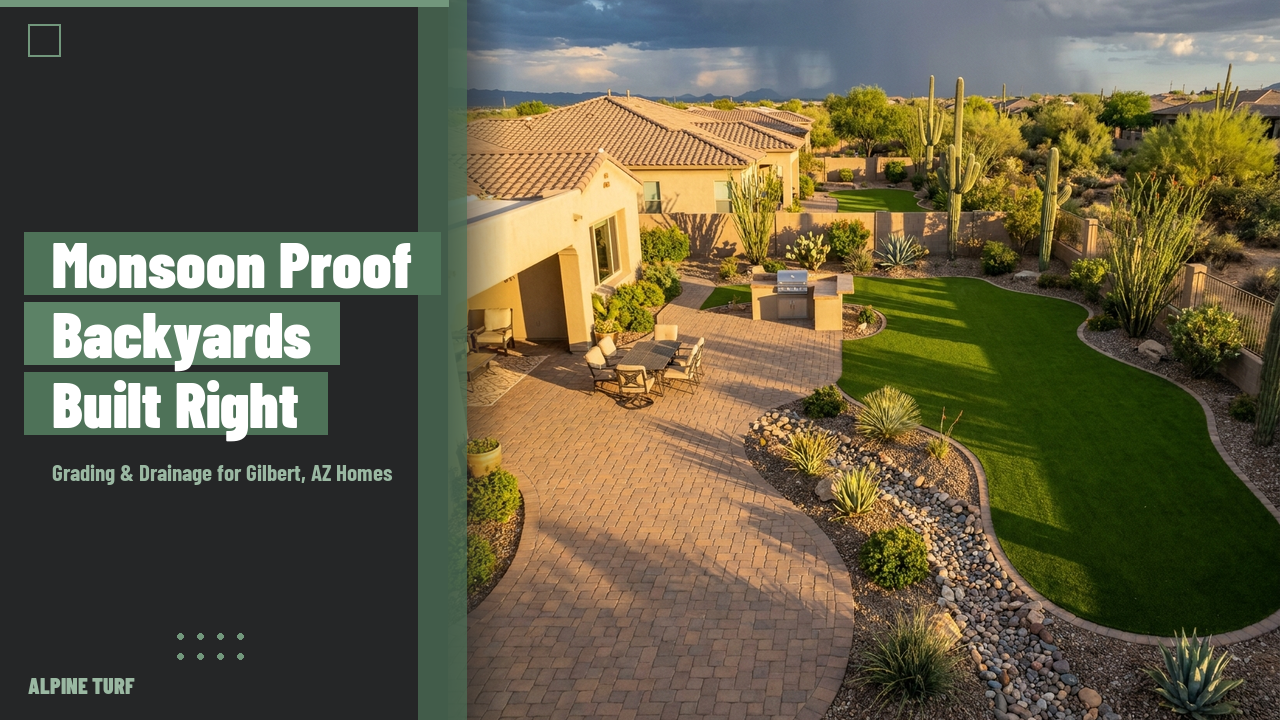
Monsoon Proof Backyard Gilbert AZ: What Grading, Drainage, and Base Prep Actually Look Like
Every July a handful of Gilbert backyards flood, pool against the house, or wash out a patio. It's almost never bad luck. It's grading, and it's fixable before the next monsoon season hits.
Every monsoon season, a handful of Gilbert homeowners call us with the same story. It rained hard for twenty minutes. Water crept up against the back slider. The side yard turned into a shallow pond that took two days to drain. None of it was a freak accident. It was a yard that was never graded to move water in the first place, and a monsoon proof backyard Gilbert AZ homes actually need starts long before anyone picks out turf or pavers.
Gilbert sits on flat ground with heavy clay and caliche subsoil that doesn't drain the way sandy desert soil elsewhere in the Valley does. Add a monsoon cell that drops an inch of rain in under an hour, and a yard with even a slightly wrong slope will hold water against your foundation, your pavers, or your turf base. This guide walks through what actually stops that: grading standards, the drainage hardware that works in Gilbert clay, how turf and paver base prep either helps or hurts, and what your HOA will and won't let you do about it.
Why Gilbert Backyards Flood Every Monsoon Season
Gilbert's elevation is almost dead flat across most of the town, somewhere around 1,250 feet with barely any natural fall from one property line to the next. That's fine on a dry February afternoon. It's a problem in July when a storm cell parks over the East Valley and drops half an inch of rain in fifteen minutes, which happens most summers according to the National Weather Service's Phoenix monsoon tracking.
Add the soil itself. Much of Gilbert sits on a clay-caliche hardpan a foot or two below the surface. Caliche is a cemented layer of calcium carbonate that barely lets water through at all, and ordinary clay isn't much better. In a yard with good percolation, a hard rain soaks in within a few hours. In a Gilbert yard with untouched subsoil, that same rain can sit on the surface for a day or more, especially in a low corner or against a block wall where it has nowhere else to go.
Newer construction makes this worse in a specific way. Builders grade the pad for the house and driveway to code, then leave the backyard as a rough, mostly flat dirt lot. Homeowners in new-build communities like Cooley Station, Layton Lakes, and Higley Groves West often install turf or pavers on that untouched grade without regrading first, which just gives the water a harder surface to pool on top of instead of a softer one to (slowly) absorb into.
The Grading Standard a Monsoon Proof Backyard Gilbert AZ Homes Need
The Town of Gilbert follows the same baseline most East Valley municipalities use: a minimum 2% slope directed away from the foundation for at least the first 10 feet, tying into swales, drains, or the street right-of-way from there. Two percent doesn't sound like much on paper. It works out to about 2.5 inches of fall over that first 10 feet, and it's the difference between water sheeting away from the house and water sitting against the stem wall.
We check grade with a laser level on every project before we touch turf, pavers, or planting beds, not after. If the existing grade is off, and on a meaningful share of the backyards we quote it is, we cut and fill dirt to reestablish that slope before anything else goes in. Skipping this step and just laying a nice paver patio or a lush strip of turf on top of bad grade is the single most common mistake we see from DIY jobs and from installers who don't check elevation first. It looks fine in October. It floods in August.
For guidance on the town's specific drainage and grading requirements for residential lots, the Town of Gilbert Engineering Department publishes the standards that apply to any regrading, drainage, or retaining work on a residential lot.
French Drains, Dry Creek Beds, and Channel Drains: What Actually Works in Gilbert Clay
Grading solves surface flow. It doesn't solve every low spot, especially in a backyard that's boxed in by block walls on two or three sides with nowhere for a simple slope to send water. That's where a real drainage system earns its keep.
French drains are the workhorse. A perforated 4-inch pipe wrapped in filter fabric, bedded in washed gravel, and sloped at a minimum of 1% carries water from a problem area to a discharge point, usually the street or an approved drainage easement. In Gilbert clay, we oversize the gravel envelope more than we would in sandier soil, because the surrounding clay won't help move water laterally into the pipe the way looser soil does. Expect $8 to $15 per linear foot installed depending on depth and how much existing hardscape has to come out first.
Dry creek beds do double duty as a decorative feature and a shallow, wide drainage channel across an open span of yard, usually lined with river rock over landscape fabric and following the natural low point of the grade. They're a good fit for backyards where the client wants a design element instead of a flat gravel strip, and they move a surprising amount of water when they're sized right.
Channel drains (also called trench drains) go in at hard transition points: the base of a paver patio, along the edge of a covered patio slab, or wherever a hardscape surface meets turf or planting beds at a low elevation. A metal or plastic grate sits flush with the surface and catches sheet flow before it can pool.
Most of the monsoon-proofing jobs we run in Gilbert combine all three: French drain along a fence line to carry water to the street, a dry creek bed crossing the open lawn area, and a channel drain at the patio edge. Which combination makes sense depends entirely on where your yard's low points actually are, which is why we start every one of these jobs with a grading assessment, not a drainage product list.
Turf and Paver Base Prep That Sheds Water Instead of Trapping It
A drainage system can be perfect and a yard can still hold water if the base underneath the turf or pavers is built wrong. We use a compacted crushed-granite base, typically 3 to 4 inches for turf and 4 to 6 inches under pavers carrying foot or vehicle traffic, and we crown or slope that base the same direction as the finished grade. A flat, uncrowned base under turf is one of the most common causes of the "my turf smells musty after it rains" complaint we hear from homeowners who had turf installed by a crew that skipped this step.
Turf itself is technically permeable when it's built correctly, with a perforated backing that lets water pass through into the base below. But that only works if the base underneath can actually drain, which means proper granite compaction and a slope that carries water to daylight instead of a bathtub-shaped depression that holds it under the turf.
For pavers, we use permeable polymeric jointing sand and a compacted base that lets water percolate between the joints rather than sheeting straight off a sealed surface into whatever's downhill. On a patio bordering a house wall, we also make sure the paver field itself slopes away from the structure at that same 2% minimum, even though it feels barely perceptible when you're standing on it.
HOA Rules for Drainage Work in Gilbert Communities
Gilbert has more HOA-governed backyards than almost any city in the East Valley, and most of the big ones, including Power Ranch, Seville, Morrison Ranch, Val Vista Lakes, and Trilogy at Power Ranch, have architectural review requirements that cover regrading, drainage structures, and anything that changes how water leaves your lot. Two things matter here.
First, Arizona follows what's known as the civil law rule on surface drainage between neighboring properties: you can alter your own lot's grading, but you can't artificially concentrate or divert water so it dumps onto a downhill neighbor's yard in a way it wouldn't have naturally. HOA architectural committees enforce this closely, because a mishandled drainage retrofit on one lot can become a flooding complaint on three others.
Second, most Gilbert HOAs require an architectural review submission for any regrading or drainage structure, even a relatively minor French drain, before work starts. We build the submission packet (grading plan, drainage direction, materials) as part of the quote for any HOA-governed property, because getting flagged mid-install for a missing approval is a scheduling headache nobody needs during monsoon season.
What It Costs to Build a Yard That Handles Monsoon Season
Drainage-only work, without a turf or paver install attached, is the cheapest way to fix a flooding problem. A single French drain run tied into an existing low spot typically runs $1,500 to $4,000 depending on length and depth. A full regrade of an average 1,800 sq ft backyard, correcting slope across the whole lot, generally lands between $2,500 and $6,000 before any surface material goes in.
Bundled into a full backyard rebuild, drainage work adds less than you'd expect because the crew is already excavating and grading as part of the turf or paver install. A complete monsoon-ready backyard combining regrading, a French drain and dry creek bed system, artificial turf, and a paver patio typically runs $18,000 to $45,000 for an average Gilbert lot, scaling with square footage and how much hardscape versus turf you want. Smaller refresh projects, just correcting grade and adding turf without pavers, can start closer to $5,000 to $8,000. If your yard also qualifies for the Gilbert grass removal incentive, that rebate applies against the turf portion of the project, not the drainage work itself.
Frequently asked questions
How do I know if my Gilbert backyard has a grading problem?
The clearest sign is standing water more than a couple hours after a storm, especially against the house, a block wall, or in a corner of the yard. Another tell is a musty smell from turf or mulch after rain, which usually means water is trapped under the surface instead of draining away. We check actual grade with a laser level on every quote, since eyeballing a slope from a foot away is unreliable.
Do I need a permit to regrade my backyard or install a French drain in Gilbert?
Routine residential regrading and drainage work on your own lot generally doesn't require a town permit in Gilbert, but it does need to follow the town's drainage standards and can't discharge water onto a neighboring property. If you're in an HOA-governed community, architectural review approval is typically required separately from any town permit. We handle both when we quote a job.
Will artificial turf make my drainage problem worse?
Only if it's installed on top of bad grade without fixing the base first. Turf itself is permeable when it's built on a properly compacted and sloped crushed-granite base. Installed correctly, turf actually improves drainage compared to bare dirt or dead grass, because water moves through the perforated backing into a base designed to carry it away instead of soaking into compacted soil.
How long does a drainage retrofit take?
A standalone French drain or dry creek bed on an existing yard typically takes 1 to 2 days. A full regrade combined with turf and paver installation runs 4 to 8 days depending on lot size and how much existing hardscape has to be removed first. We avoid scheduling excavation work during active monsoon storm windows, which can shift timelines by a day or two in July and August.
Can I fix drainage myself before calling a landscaper?
Small fixes like extending a downspout or adding mulch to a low spot can help at the margins, but they don't correct an underlying grading problem. DIY regrading without a laser level or transit almost always ends up close but not accurate enough, and a slope that's off by even half a percent can be the difference between water draining away and water sitting for a day. For anything beyond minor touch-ups, we recommend starting with a professional grade check.
What happens if I skip drainage work and just install turf or pavers?
If the underlying grade is already correct, you may not need additional drainage hardware at all, and plenty of Gilbert yards don't. But if the grade is off and you install turf or pavers without correcting it, you're building an expensive surface on top of the same flooding problem. Water will pool under turf, causing odor and eventual seam issues, or pond on a paver patio and stain or shift the base over a few monsoon seasons.
Get your monsoon-ready backyard quote
We grade, drain, and build backyards across Gilbert and the East Valley that actually hold up to monsoon season. Free on-site assessment with a real laser-level grade check, no obligation.
Book your free quote →