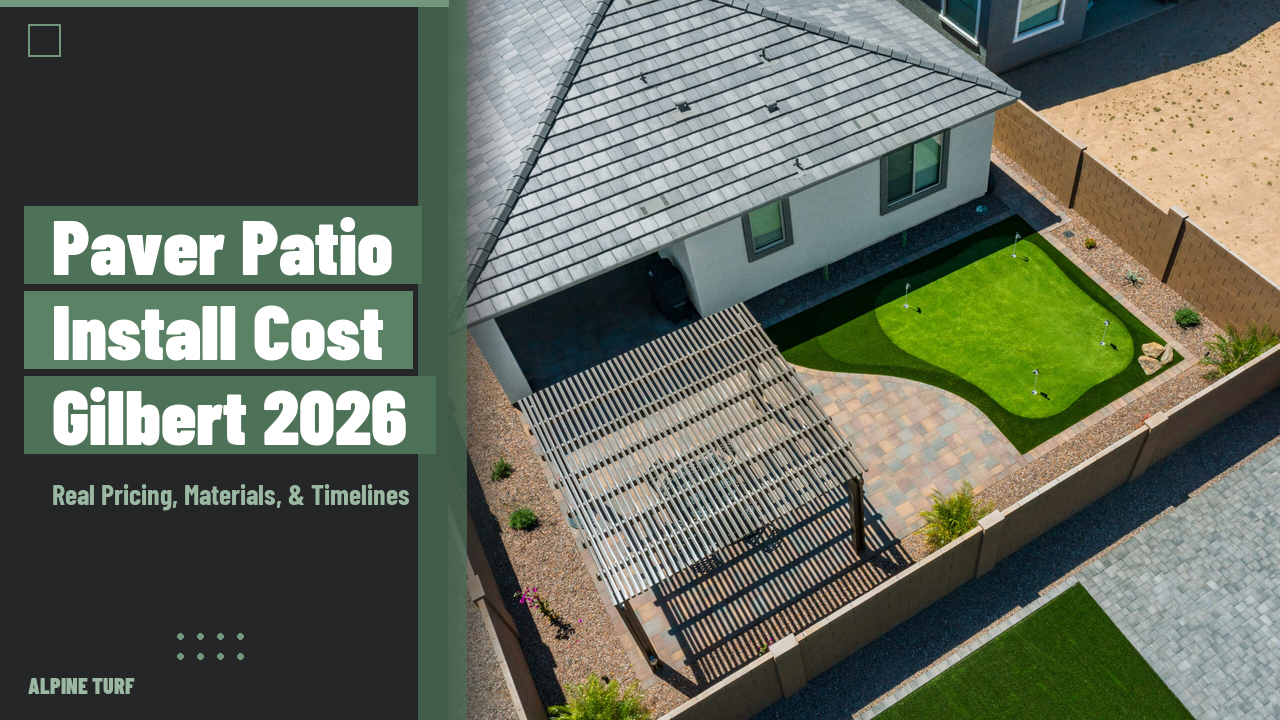
Paver Patio Installation Cost in Gilbert AZ (2026 Guide)
Real 2026 pricing for paver patios in Gilbert. What the per-square-foot quote actually includes, what the material upgrades cost, the base-prep work that protects the install, and the timeline from contract to walk-through.
Three contractors quote your paver patio at $4,500, $11,000, and $19,000 for what looks like the same project. Which one is right? The honest answer: all three can be, because most paver patio quotes in Gilbert do not include the same scope. The difference is buried in base prep, material grade, pattern complexity, and the drainage details that decide whether your patio lasts 5 years or 25.
This guide breaks down the real paver patio installation cost in Gilbert AZ for 2026: the per-square-foot ranges, what each material actually costs installed, the base-prep work that does not show up on the quote but absolutely shows up in the result, and the timeline from contract to walk-through.
Paver patio installation cost in Gilbert AZ: 2026 pricing overview
Across the paver patios we have installed in Gilbert over the last year, installed cost lands in three roughly even tiers. These ranges include materials, base prep, labor, edge restraints, polymeric sand, and the warranty. They do not include lighting, structures, or any features beyond the patio itself.
For a typical Gilbert paver patio install size of 300 to 600 square feet, the math works out to:
- Small patio extension (200 to 300 sq ft): $3,000 to $9,500 depending on material
- Standard patio (300 to 500 sq ft): $5,000 to $16,000
- Large patio with walkways (500 to 800 sq ft): $8,000 to $25,000
- Full backyard hardscape (800+ sq ft, multiple zones): $14,000 to $35,000+
The per-square-foot range moves with the same factors every time: material grade, base depth, pattern complexity, the cut count for non-rectangular areas, and demo of any existing concrete or pavers.
Material comparison: concrete vs. travertine vs. porcelain
Material choice is the single biggest decision driver for paver patio cost in Gilbert. Each has trade-offs in price, look, heat tolerance, and longevity.
| Material | Installed cost | Best for | Drawback |
|---|---|---|---|
| Concrete pavers | $14 to $20/sq ft | Budget-conscious, modern aesthetic, fastest install | Can fade over 10+ years; less premium feel |
| Travertine | $22 to $32/sq ft | Classic AZ look, stays cooler underfoot, pool decks | Sealing needed every 2 to 3 years |
| Porcelain pavers | $25 to $35+/sq ft | Premium modern look, lowest maintenance, no fading | Highest material cost, requires expert install |
| Natural flagstone | $28 to $42+/sq ft | Custom organic look, no two pieces alike | Variable thickness adds labor; harder to seam |
Concrete pavers are still the volume leader in Gilbert installs. Modern manufacturers like Belgard and Pavestone make concrete pavers that look almost identical to travertine for half the price. For Family Build and HOA-restricted budgets, concrete pavers in tan or sandstone tones are the smart play.
Travertine is the most popular Gilbert choice for clients who want the premium look without porcelain pricing. The big advantage in AZ specifically: travertine stays measurably cooler underfoot than concrete or porcelain in direct summer sun. Pool decks especially. The trade-off is that travertine needs sealing every 2 to 3 years to maintain its color and resist staining.
Porcelain pavers are the premium choice for ultra-modern designs. Zero fading, zero sealing, easiest maintenance. The catch: porcelain is unforgiving to install. Cuts need a wet saw, joints have to be perfect, and base prep mistakes show through. Hire an installer who has built with porcelain before, not someone learning on your project.
The base prep work that decides if your patio lasts 5 years or 25
Here is the single biggest cost-quality decision on any Gilbert paver patio: the depth and quality of the base underneath the pavers. The pavers themselves only last as long as the base below them holds shape. Skimp on base and the patio heaves, separates, and slopes within 3 to 5 years. Build the base right and the same install lasts 20+ years.
A proper Gilbert paver base for clay-and-caliche soil includes:
- 4 to 6 inches of compacted crushed granite (also called ABC base). Compacted in 2-inch lifts to 95 percent density. Skipping this layer or using uncompacted fill is the most common shortcut and the most expensive long-term mistake.
- 1 inch of leveling sand (concrete sand or paver bedding sand). Screed-leveled to a uniform thickness. Mason sand from a hardware store is not the right product; it compacts wrong.
- Edge restraints. Plastic or aluminum paver edging spiked into the base, around the entire perimeter. Without edge restraint, the pavers spread outward over time.
- Polymeric sand joint fill. Swept into the joints, then activated with water. Polymeric sand locks pavers together, blocks weeds, and resists ant tunneling.
- Proper slope for drainage. A 2 percent slope away from the house (about 1/4 inch per foot) is the standard. Less than that and water pools; more than that and the patio feels tilted.
The cost difference between a cheap base prep and the right base prep is typically $2 to $4 per square foot. On a 500 sq ft patio that is $1,000 to $2,000. It is also the single best investment you can make in the project. Any quote that does not specify base depth and compaction is leaving the homeowner exposed.
Permits, HOA approval, and Gilbert town rules
The good news: most paver patio installs in Gilbert do not require a Town building permit. Standard at-grade paver patios under 200 square feet and replacement of an existing patio area generally do not trigger a permit per the Town of Gilbert Development Services. Permits become required when you alter drainage in a way that affects neighboring properties, when you build an attached structure (covered patio, roof extension), or when the patio is part of a larger project that includes electrical or gas.
HOA approval is a different story. Nearly every Gilbert HOA requires architectural review for paver patios, including:
- Power Ranch, Morrison Ranch (and every village within), Agritopia, Seville, Trilogy at Power Ranch, Adora Trails, Marbella Vineyards, Layton Lakes, and the rest of the Gilbert master-planned communities
Each HOA has its own approved material colors, paver pattern restrictions, and visibility rules. The most common HOA hangups: bright white travertine that does not match the community palette, modern grey concrete pavers in older traditional-aesthetic neighborhoods, and patios that extend past the home's footprint into view of common areas.
Plan 2 to 4 weeks for HOA review on top of the install timeline. Submit a clear plan with the material samples, dimensions, and color matched to the community palette and approval is usually straightforward.
Timeline: contract to walk-through
Most Gilbert paver patio installs run on this timeline:
- Initial consult to signed contract: 1 to 2 weeks (design revisions, quote tuning, material samples)
- HOA submission to approval: 2 to 4 weeks (concurrent with material orders)
- Material lead time: 1 to 3 weeks (longer for special-order porcelain or custom travertine cuts)
- Site demo (if existing patio is being removed): 1 to 2 days
- Excavation and base prep: 1 to 2 days for a 300 to 600 sq ft patio
- Paver install: 2 to 4 days for a 300 to 600 sq ft patio
- Edge restraint, polymeric sand, final clean-up: 1 day
- Final walk-through: Day after completion
Total: 3 to 5 weeks from contract to walk-through on a typical Gilbert install. Custom patterns, larger square footage, or multi-zone installs (patio plus walkways plus fire-pit pad) extend the active install phase by a few days each.
What actually drives the price up or down on your quote
Real cost drivers on a Gilbert paver patio, in rough order of impact:
- Material choice. Largest single driver. Concrete vs. travertine vs. porcelain can swing the per-sq-ft cost by $8 to $20.
- Base depth and prep quality. $2 to $4 per sq ft difference between cheap and right.
- Pattern complexity. Herringbone, soldier courses, and contrasting border patterns add labor. Running bond is the fastest and cheapest pattern.
- Cut count. Curved patios, multiple corners, and integration with existing hardscape mean more cuts, slower install, and a higher labor line item.
- Demo of existing concrete or pavers. $2 to $5 per sq ft of demo work if you are tearing out a previous patio.
- Drainage corrections. Existing yard drainage issues that need addressing add $500 to $3,000.
- Accessibility. Backyards without good access (narrow side gates, long walks from the driveway) add labor for material staging and debris haul-out.
- Edge upgrades. Soldier-course or contrasting border pavers add $4 to $8 per linear foot of perimeter.
Where to save (and where you really should not)
Some line items on a paver patio quote are flexible. Others look like savings now and become expensive problems later. The honest split:
| Line item | Safe to cut? | Why |
|---|---|---|
| Material upgrade (travertine vs. concrete) | Yes | Modern concrete pavers look great and save $8 to $14/sq ft |
| Patio size | Yes | Easier to extend later than to oversize now |
| Pattern complexity | Yes | Running bond looks clean and saves labor |
| Contrasting border | Yes | Visually nice but not structural |
| Base depth and compaction | No | The whole install rides on the base; cheap base fails in 3 to 5 years |
| Edge restraint | No | Without edge restraint, pavers spread outward and joints separate |
| Polymeric sand joint fill | No | Locks pavers together, blocks weeds and ants |
| Drainage slope | No | Wrong slope means standing water, foundation issues, and rapid degradation |
What Alpine Turf handles on a Gilbert paver patio install
Most paver installs in Gilbert are run by hardscape specialists who only do hardscape. We approach it differently because most paver patios are part of a larger backyard install. Alpine Turf coordinates the patio with everything that has to be sequenced around it: irrigation runs, drainage corrections, plant placement, structures like pergolas, and turf installation.
Specifically:
- On-site measure with paver samples in the materials you are considering
- 3D design rendering so you see the finished patio before any work starts
- HOA submission package handled (Power Ranch, Morrison Ranch, Agritopia, Seville, and the rest of Gilbert's HOAs)
- Demo and disposal of any existing concrete or paver surface
- Full base prep: excavation, compacted crushed-granite base in 2-inch lifts, leveling sand
- Paver install in your chosen material and pattern
- Edge restraint, polymeric sand, and final cleanup
- Coordination with any pergola, fire pit, outdoor kitchen, or turf install happening alongside
- Final walk-through and 5-year workmanship warranty
How to get a Gilbert paver patio quote
Recommended sequence:
- Measure your existing patio (or pace off the new patio area) and note any drainage or grade issues.
- Identify your HOA and pull up the approved paver palette and pattern restrictions for your community.
- Pick 2 to 3 material options you would consider (concrete pavers in a tan tone, travertine, porcelain in a specific color).
- Book a free on-site consult with Alpine Turf. We measure, walk through material samples, talk through pattern options, and quote within 10 to 15 percent on the first visit.
- Approve the design. We finalize the package, submit to HOA, and lock in the install schedule.
Most Gilbert paver patio quotes are within 10 to 15 percent of final price on the first visit and locked exactly at contract.
Frequently asked questions
How much does paver patio installation cost in Gilbert AZ on average?
Installed cost ranges from $14 to $35+ per square foot in 2026 depending on material. Concrete pavers run $14 to $20 per sq ft, travertine runs $22 to $32, and porcelain pavers run $25 to $35+. For typical Gilbert patio sizes of 300 to 600 square feet, that works out to $5,000 to $20,000 total. Larger or premium projects can exceed $25,000.
Do I need a permit for a paver patio in Gilbert?
Most at-grade paver patio installs in Gilbert do not require a Town building permit. Permits become required when you alter drainage that affects neighbors, when you attach a structure (covered patio, roof extension), or when the project includes electrical or gas. HOA approval is required in nearly every Gilbert community regardless of whether a Town permit is needed.
Which paver material is best for Arizona heat?
Travertine stays measurably cooler underfoot than concrete or porcelain in direct summer sun, which is why it dominates Phoenix-area pool decks and high-use patios. Light-colored concrete pavers (tan, sandstone, soft beige) also stay cooler than dark grey or charcoal. Avoid black or dark grey pavers on uncovered patios that get full afternoon sun.
How long does a paver patio last in Gilbert?
A properly installed paver patio with the right base prep lasts 20 to 25 years before any significant work is needed. Pavers themselves are essentially permanent; the failure point is always the base underneath them. Patios installed with skimped base or no edge restraint typically heave, separate, and need rework in 5 to 8 years.
How long does it take to install a paver patio in Gilbert?
Active install time is 4 to 7 days on-site for a 300 to 600 square foot patio. Total timeline from contract to walk-through is 3 to 5 weeks including design, HOA submission, material lead time, and the install itself. Larger projects with multiple zones or custom patterns can extend the active install phase by a few days each.
Can pavers go directly over existing concrete?
Sometimes, but rarely the right call in Gilbert. Existing concrete patios in Gilbert usually have cracks, settlement issues, or improper slope that the new pavers will inherit. The cleaner long-term install is demo of the old concrete and a fresh compacted base. Overlay installs are an option for limited-budget situations where the existing concrete is in like-new condition, which is uncommon after 5+ AZ summers.
Get your Gilbert paver patio quote
We design and install paver patios across every Gilbert HOA community - Morrison Ranch, Power Ranch, Agritopia, Seville, Trilogy, Adora Trails, and the rest of the East Valley. Free on-site consult with material samples, tiered quote, and HOA submission handled.
Book your free quote →