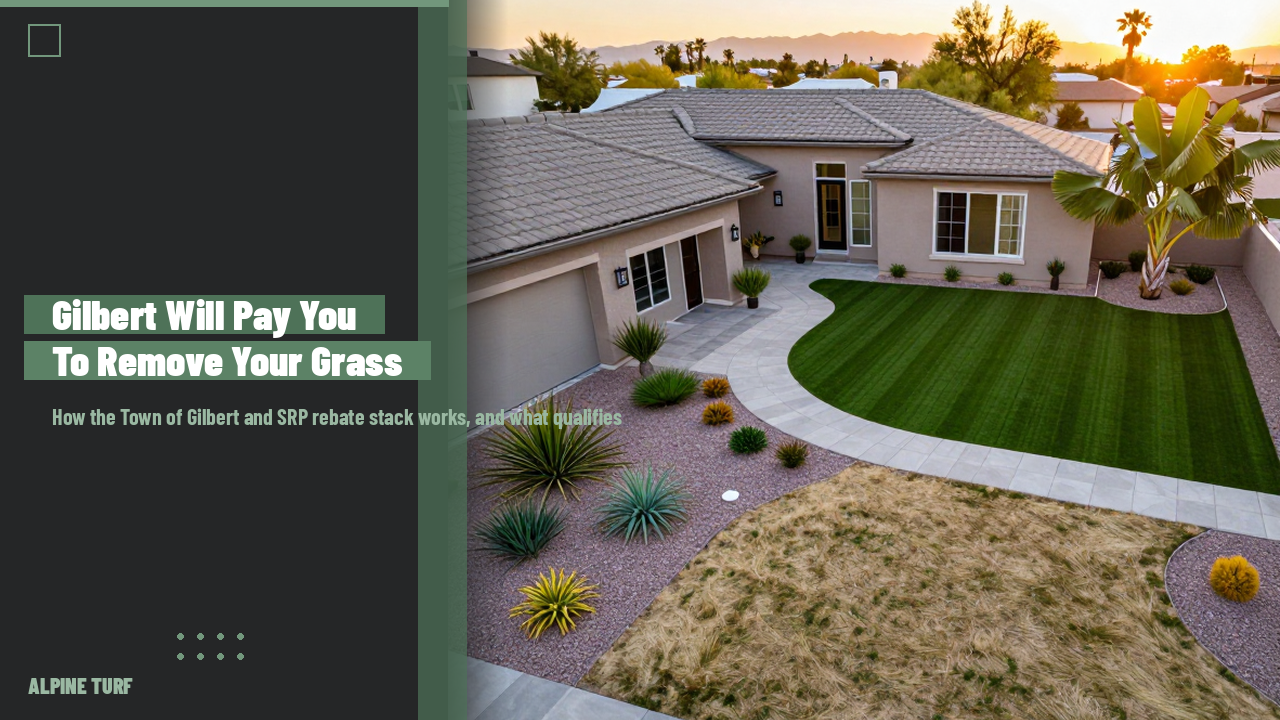
Gilbert Grass Removal Incentive: How Much You Can Get Back in 2026
Gilbert and Salt River Project split the cost of ripping out thirsty lawns. Homeowners can collect up to $1,050. HOAs and businesses can collect up to $6,000 per project. Here is exactly who qualifies, how the two programs differ, and the paperwork order that keeps a rebate from getting denied.
If you live in Gilbert and you are staring at a water bill that spikes every time the East Valley hits 110 degrees, here is some good news: the Gilbert grass removal incentive will pay you to rip out that thirsty lawn and replace it with something that actually makes sense in the desert. Homeowners can collect up to $1,050. HOAs and businesses can collect up to $6,000 per project through a partnership between the Town of Gilbert and Salt River Project. The program has been running since 2023, and in 2026 the town is actively pushing to expand it, not wind it down.
The catch, like every East Valley rebate program, is the paperwork. Apply after the grass is already out and the rebate is gone no matter how good the new xeriscape looks. This guide walks through exactly what Gilbert and SRP pay in 2026, who qualifies, the difference between the residential and non-residential tracks, what a qualifying replacement landscape actually has to look like, and how the timing of the town's newest funding push affects when you should apply.
How much is the Gilbert grass removal incentive worth in 2026?
Gilbert actually runs two separate rebate tracks, and the size of the check depends entirely on which one applies to your property. Residential homeowners work with the Town of Gilbert directly. HOAs, businesses, and other non-residential customers work with a joint Town of Gilbert and SRP program that pays out at a much higher rate.
On the residential side, the Town of Gilbert pays up to $800 to homeowners who remove live, irrigated grass and replace it with a qualifying low-water landscape. Stack an additional $250 for installing a new smart irrigation controller that automatically adjusts watering based on weather, and a single-family homeowner can walk away with up to $1,050 back. Both rebates require a genuinely new, currently irrigated lawn on the front end, so a yard that has already gone dormant or dead does not qualify as easily as a green, actively watered one.
On the non-residential side, the numbers are a different order of magnitude. Through the Town-SRP partnership, HOAs, businesses, and other non-residential water customers can earn $2 per square foot of qualifying grass removed, up to a cap of $6,000 per project. SRP backs the program with dollar-for-dollar matching funds of roughly $15,000 per year for five years, committing about $75,000 total on top of what the town itself puts in. For an HOA common area or a business courtyard, that funding stack turns a grass-to-xeriscape conversion from a discretionary expense into something close to a break-even project before you even count the water savings.
Both programs pay out on a first-come, first-served basis with a capped annual budget. Once the year's funds are allocated, the town stops accepting new applications until the next fiscal cycle. Current rates, forms, and program status are posted on the Town of Gilbert's water conservation rebates page, and the non-residential match program is documented directly by SRP. If you are on the fence, the funding-cap detail above is the one that should push you toward applying sooner rather than later.
Who qualifies for Gilbert's grass removal rebate
Eligibility rules differ slightly between the residential and non-residential tracks, but a few requirements are constant across both.
- You have to be a Town of Gilbert water customer. Not every address inside Gilbert town limits is actually served by Gilbert water. Pockets of the town, especially near the Chandler and Mesa borders, are served by a neighboring city's utility or a private water company. Check your water bill before you spend time on an application.
- The grass has to be live and currently irrigated. Both programs are built to convert real, actively watered turf grass. Dead or dormant lawns that have already been off irrigation for a while, bare dirt patches, and decorative ornamental grass beds generally do not count the same way a green lawn does.
- The replacement has to be a genuine low-water landscape. Gravel dumped over dirt does not qualify on its own. The converted area needs real desert-adapted plants on efficient irrigation, not just rock.
- Applications must be submitted before demolition starts. Every East Valley rebate program we have worked with, Gilbert included, requires a pre-inspection to confirm the existing grass before anything gets removed.
One detail that trips up new Gilbert homeowners: if a previous owner already claimed a rebate on a section of the property, that same patch of grass generally cannot be rebated again under a new owner. If you recently bought a home and are planning a conversion, it is worth confirming with the town's water conservation office whether the yard has rebate history before you build a budget around it.
Residential vs. HOA and business: which program applies to you
The two programs share the same underlying goal but pay out on completely different scales. Here is the side-by-side.
| Detail | Residential | Non-residential (HOA / business) |
|---|---|---|
| Who it covers | Single-family homeowners | HOAs, businesses, other non-residential accounts |
| Base rebate | Up to $800 | $2 per sq ft removed |
| Bonus / cap | +$250 for smart irrigation controller | Capped at $6,000 per project |
| Funding source | Town of Gilbert | Town of Gilbert + SRP dollar-for-dollar match |
| Typical use case | Front yard or backyard lawn conversion | Common areas, entryways, courtyards, medians |
Most Alpine Turf clients calling about "the Gilbert grass rebate" are homeowners, and the residential track is what they need. But we get a steady stream of calls from HOA boards and property managers who assume the smaller residential numbers apply to their common areas, when the non-residential program pays out far more generously per square foot. If you manage an HOA, a strip mall, or a corporate campus in Gilbert, it is worth confirming which track your account falls under before assuming the rebate is not worth pursuing.
Step-by-step: how to apply for the Gilbert grass removal incentive
The sequence matters more than almost any other detail in this guide. Get the order wrong and a well-executed conversion still loses the rebate.
- Confirm your water utility and program track. Pull a recent water bill to confirm you are a Town of Gilbert customer, and figure out whether you fall under the residential or non-residential program.
- Apply before touching the grass. Submit your application through the Town of Gilbert's water conservation rebate portal, including photos of the existing lawn and a rough sketch of the conversion area.
- Wait for pre-approval and, where required, a pre-inspection. The town verifies the existing grass and the proposed plan before you spend money on demo or materials. Do not start removal until you have written approval in hand.
- Complete the conversion. Remove the grass, install the qualifying low-water plants, set up efficient irrigation, and add any hardscape or decorative gravel that is part of the design.
- Submit final documentation. Photos of the finished landscape, receipts for plants and irrigation materials, and an updated sketch showing what was actually installed.
- Pass final inspection. A town inspector confirms the completed work matches what was approved and meets the low-water landscape requirements.
- Receive your rebate. Approved final inspections trigger payment. Budget several weeks to a few months for the check to arrive, since exact processing times shift with how many applications the town is working through that quarter.
Because minimum project sizes, documentation requirements, and processing windows have shifted across past program years as Gilbert has adjusted funding, always confirm the current fine print directly at gilbertaz.gov/WaterRebates or with the water conservation office before you finalize a design. We build every quote around whatever the live rules say at the time of application, not last year's numbers.
What counts as a qualifying low-water landscape
This is the rule that catches the most homeowners and HOA boards off guard. Gilbert does not pay you to swap a lawn for bare rock. The replacement has to function as a real low-water landscape, not just look like one from the street.
Real plant coverage. The converted area needs a meaningful percentage of desert-adapted plants, not a sea of gravel with three token cacti. Native and low-water species like red yucca, brittlebush, desert spoon, agave, lantana, and desert-adapted trees such as palo verde, mesquite, and desert willow are the backbone of a design that passes inspection.
Efficient irrigation. Spray heads left running in a converted zone are one of the fastest ways to fail. The replacement landscape needs efficient, low-flow irrigation, typically drip, sized to the new plant palette rather than the old lawn.
Genuine conversion, not a cosmetic patch. The town wants to see the full qualifying area actually converted, matching the sketch and photos submitted with the application. Partial conversions or designs that shrink dramatically between approval and final inspection risk a reduced or denied rebate.
Synthetic turf is a design choice, not the rebate qualifier. Artificial turf reduces water use and looks great year-round in Arizona heat, but the grass removal rebate itself is built around low-water plant landscapes on efficient irrigation. Many of the yards we design combine a turf zone for kids or pets with a rebate-qualifying low-water plant zone elsewhere on the property, capturing the rebate on the planted portion while still getting the durability of turf where it matters most to the homeowner.
The 2026 funding expansion, and why timing matters
Gilbert is not treating this as a quiet legacy program. In May 2026, the Town Council moved to pursue a federal WaterSMART Small-Scale Water Efficiency grant through the Bureau of Reclamation, aimed at bringing an additional $250,000 to the non-residential grass removal effort, split roughly between a $125,000 federal award and a $125,000 local match. Since the non-residential program launched in 2023, Gilbert has already funded around 15 projects that removed roughly 149,600 square feet of grass, and town staff expect the new funding to support tens of thousands of additional square feet of conversions.
Two things fall out of that for anyone weighing a project. First, this is a program the town is actively growing, driven by real Colorado River supply concerns rather than a one-time budget line that could quietly disappear. Second, expanded funding does not mean unlimited funding in any given year. Rebates are still first-come, first-served, and a fresh round of dollars tends to draw a wave of new applications right behind it. If a conversion has been on your list, getting your application in early in the fiscal year (which starts July 1) keeps you ahead of that wave instead of behind it.
The real cost math: rebate plus water savings
The rebate check is a nice head start, but the bigger, permanent return comes from the water bill, which drops the day the grass is gone.
A modest 1,000 to 1,200 square foot patch of turf grass in Gilbert typically drinks somewhere in the range of 50,000 to 70,000 gallons a year to stay green through an Arizona summer. At current tiered Gilbert water rates, that can run several hundred dollars a year on that section of yard alone. A converted low-water landscape on the same footprint uses a fraction of that, often cutting the water bill on that portion of the yard by half or more.
Run the math on a typical $12,000 to $15,000 residential front yard conversion:
- Project cost: $12,000–$15,000 for demo, drip irrigation, decorative gravel, and desert-adapted plants
- Rebate: up to $1,050 (base $800 plus $250 smart controller bonus) trims the net cost
- Annual water savings: often a few hundred dollars a year on that section of the property, plus the time and cost of mowing, edging, and reseeding that simply goes away
- Lifetime savings: over a 15 to 20 year holding period, the water and maintenance savings alone can return several thousand dollars to your pocket
For HOA and commercial clients, the math is more dramatic because the non-residential rebate covers a much larger share of the upfront cost. A 3,000 square foot common-area conversion at the $2 per square foot rate hits the $6,000 cap outright, which on a mid-size hardscape-and-planting project can offset a meaningful chunk of the total bill before the ongoing water savings even start compounding.
What Alpine Turf handles on the rebate paperwork
Most installers will hand you a quote and let you figure out the rebate application on your own. We do it differently. Every Gilbert grass-removal conversion Alpine Turf installs includes rebate paperwork managed end to end, so a missed form or a skipped inspection does not cost you money you already earned.
Specifically, our rebate-handling service includes:
- Confirming Gilbert water utility eligibility and the correct program track before quoting the project
- Submitting the initial application with required photos and measurements
- Coordinating any required pre-inspection and being on-site to walk the plan with the inspector
- Designing the replacement landscape to comfortably clear the plant-coverage and irrigation requirements
- Keeping itemized receipts and documentation organized throughout the install
- Submitting final paperwork once the project wraps and coordinating the final inspection
For homeowners and HOA boards who would rather run the paperwork themselves, we still hand off the qualifying plant list, a site sketch in the format Gilbert wants, and the itemized receipts needed for the final submission. Either way, the goal is the same: a landscape that clears every rebate rule and the maximum check the program allows.
Frequently asked questions
How much is the Gilbert grass removal incentive?
Gilbert homeowners can get up to $800 for converting live grass to a low-water landscape, plus up to $250 more for installing a new smart irrigation controller, for a possible $1,050 total. HOAs and businesses can earn $2 per square foot of grass removed, up to $6,000 per project, through a matching program between the Town of Gilbert and Salt River Project (SRP).
Who qualifies for the Gilbert grass removal rebate?
You need to be a Town of Gilbert water customer with live, currently irrigated grass on the property. The replacement landscape has to be a genuine low-water landscape with efficient irrigation, not bare gravel. Residential homeowners use the base program, while HOAs and businesses use the larger non-residential program backed by SRP matching funds.
Do I have to apply before removing the grass?
Yes. Every East Valley rebate program, Gilbert included, requires an application and pre-approval before demolition starts. Once the grass is gone, there is nothing left for an inspector to verify, and starting removal early is one of the most common reasons a rebate gets denied.
Does the HOA and business rebate really pay more than the residential one?
Yes, substantially more. The non-residential program pays $2 per square foot of qualifying grass removed, up to $6,000 per project, funded through a dollar-for-dollar match between the Town of Gilbert and SRP. The residential program tops out around $1,050 combined between the base rebate and the smart irrigation bonus.
Can I just put down gravel after removing the grass?
No. Both the residential and non-residential programs require the replacement to be a real low-water landscape with genuine plant coverage on efficient irrigation, not a bare gravel yard. Designs that are mostly rock with token plants risk failing final inspection.
Is the funding actually going to run out?
Both programs are first-come, first-served with a capped annual budget, so yes, funds can and do run out before the fiscal year ends. In May 2026 the Town of Gilbert applied for a $250,000 federal WaterSMART grant specifically to expand the non-residential program, which signals continued town investment, but applying earlier in the fiscal year (which starts July 1) still gives you the best odds of securing funding.
Get your Gilbert rebate-qualified xeriscape quote
We design and install rebate-qualifying grass-removal conversions across Gilbert, Chandler, Mesa, Queen Creek, and the rest of the East Valley. Free on-site consult, tiered quote, and we handle the rebate paperwork end to end.
Book your free quote →