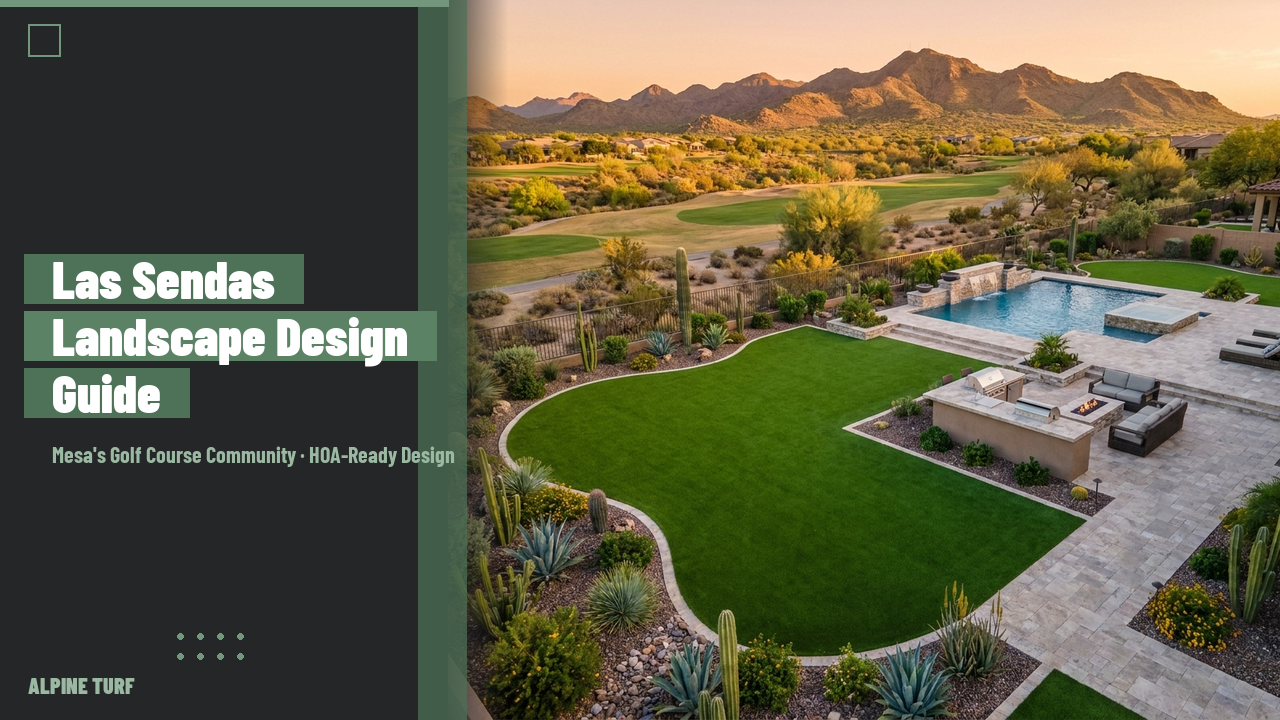
Las Sendas Landscape Design: What the ARC Actually Allows
Las Sendas publishes its Design Guidelines online, which puts it ahead of most East Valley HOAs — but the front-yard turf cap, header rules, and gazebo setbacks catch homeowners off guard anyway. Here's what the current guidelines say, plus real cost ranges for turf, pavers, and outdoor living.
A Las Sendas landscape design project starts in a better spot than most East Valley HOAs: the Community Association actually publishes its Design Guidelines online, current as of a October 2025 revision, instead of making you call the management office for a copy. That's the good news. The catch is that homeowners still show up to their first Architectural Review Committee submittal not knowing that front-yard turf is capped at a specific percentage, that the guidelines reject five different types of turf edging outright, or that a backyard gazebo needs 15 feet of clearance from the boundary wall. We've pulled full backyards for families in Stonecliff and turf refreshes for interior lots off Eagle Crest, and the guidelines catch someone on almost every job.
Las Sendas is a 3,400-home master-planned community in east Mesa, built around a Robert Trent Jones Jr. golf course that opened in 1995 and climbs into the foothills of the Usery Mountains. Lot sizes swing harder here than almost anywhere else in the East Valley, from roughly 1,100 sq ft starter homes to custom estates north of 10,000 sq ft, spread across named villages like Cobblestone, Founders Ranch, Granite Preserve, Legacy Hills, Mountain Village, Stonecliff, Trailridge, and Vintage Hills. That range means a Las Sendas landscape design can be a $16,000 turf-and-paver refresh on a production lot or a six-figure custom outdoor living build on a golf-course estate, and the ARC review looks different depending on which one you're doing. This post walks through what the current guidelines actually say, what it costs to build against them, and how we handle the review process on every Las Sendas job we run.
What actually governs a Las Sendas landscape design project
Las Sendas is managed by CCMC, and the Association runs two separate Architectural Review Committees: one for production homes and one for custom homes. The production ARC meets the second and fourth Thursday of each month; the custom ARC meets the first and third Thursday. Either way, your application needs to land at least two weeks before the next meeting, and the committee has 30 days from a complete submittal to issue a decision. An incomplete packet doesn't get a quick follow-up email, it goes back into the queue behind that month's other submittals.
The guidelines are explicit that no excavation, grading, or drainage change happens on any lot without prior ARC approval, and that includes changes that could affect a neighbor's drainage or the community's common areas. That's a bigger deal in Las Sendas than in flat East Valley subdivisions, because so many lots here sit on graded hillside pads. We pull the current Design Guidelines PDF directly from mylassendas.org before we draw a plan, so the plot plan, header details, and material samples we submit match the version the ARC is reviewing against this year, not a copy a neighbor handed down.
Setbacks themselves aren't spelled out as a flat HOA number. The guidelines point back to the recorded plat for each lot through Maricopa County, which is normal for a community with this much lot variation, but it means your installer needs your actual plat on hand before finalizing a design, not a generic East Valley assumption.
Front-yard turf: the 25% cap and the header rule that trips people up
Every type of turf, natural or artificial, needs ARC approval before it goes in the ground. For front yards specifically, the current guidelines cap turf at 25% of the total front-yard landscape area, defined as everything from the back of the sidewalk or curb to the face of the house and the side yard in front of the return wall, minus whatever square footage the driveway eats up. That's a hard ceiling. We measure it before we ever draw a layout, because a design that reads fine on paper can quietly blow past 25% once you subtract the driveway.
The part that actually catches people is the header requirement. Turf areas need a concrete or masonry header at least 4 inches wide, full stop. The guidelines specifically reject rock, railroad ties, plastic, steel, and redwood header board, and they call out that professional metal edging isn't acceptable as an artificial turf border either, even though metal edging is the default in most non-HOA Arizona yards. A sample of the artificial turf and the border material has to go in with the ARC application. Skip that sample and the packet goes back.
- Front-yard turf area: capped at 25% of the landscape area (sidewalk/curb to house face, less driveway).
- Header: concrete or masonry, minimum 4 inches wide. No rock, railroad ties, plastic, steel, or redwood.
- Metal edging: not approved as a turf border, even though it's standard elsewhere in the Valley.
- Submittal: physical turf and border samples required with the application.
- Natural turf: if you go that route instead, it must run on automatic underground irrigation and stay weed-free.
Backyard design: golf-course lots and villages without a stated turf cap
Here's the detail most homeowners never notice on their own read of the guidelines: the 25% turf cap is written specifically under "Turf (Front Yard)." There's no matching backyard section with its own percentage limit. That doesn't mean anything goes in a rear yard, everything still needs ARC approval and the same header and sample rules apply, but it does mean we have real design flexibility on backyards that we don't have out front, which matters a lot on the larger golf-course and hillside lots.
Golf-course frontage adds its own considerations. Las Sendas' course plays through the Usery Mountain foothills with real elevation change, and lots backing to the fairway or to open desert typically want the design to frame the view rather than wall it off, which shapes where we put turf, planting beds, and any raised patio or fire feature. View decks specifically are not allowed in eight of the named villages: Cobblestone, Founders Ranch, Granite Preserve, Legacy Hills, Mountain Village, Stonecliff, Trailridge, and Vintage Hills. If a homeowner is counting on a raised deck to capture a mountain view in one of those villages, that plan needs to change before it ever reaches the ARC.
Because setbacks trace back to the individual plat rather than a flat community-wide number, we treat every Las Sendas backyard as its own survey problem before we finalize turf shape, paver layout, or where a pergola can legally sit relative to the boundary wall. Hillside pads in villages like Stonecliff and Legacy Hills also tend to expose the same rocky caliche layer we deal with across the East Valley foothills, which changes how deep we can dig a proper turf base without hitting rock.
Patios, pavers, and hardscape under the current guidelines
Hardscape covers any concrete, pavers, brick, block, or tile not addressed elsewhere in the guidelines, and it all needs ARC sign-off. A few specifics that shape how we plan a Las Sendas patio or paver project:
- Driveways: colored concrete, brick pavers, and stamped concrete patterns are allowed with approval; only one driveway entrance per lot.
- Driveway extensions: capped at 24 inches total and must be concrete or pavers. RV-access extensions to the rear yard are not allowed.
- Walkways: maximum 48 inches wide, and they can't block the lot's natural drainage path. Flaring a walkway wider to meet a gate is fine with design approval.
- Patios: new patios and any extension to an existing patio need prior ARC approval before work starts.
- Rock ground cover: no artificially colored aggregate anywhere. Rock and decomposed granite has to read as a natural desert tone.
That last rule surprises transplants from other states more than anything else on this list. The dyed red or black rock that's common in Midwest and East Coast landscaping doesn't clear ARC review here, and it wouldn't fit the desert palette we're building around anyway.
Fire pits, pergolas, and outdoor living structures
Alpine Turf builds full outdoor living spaces, not just turf, and Las Sendas' guidelines are specific enough on this category that it's worth planning around from day one rather than adjusting after a rejected submittal.
- Gazebos, pergolas, and ramadas: rear-yard only, capped at 10 feet in height, and need a minimum 15-foot setback from any boundary wall. Paint should match the house color scheme.
- Attached patio covers: wood, masonry, concrete, stone, or coated aluminum, matching the house's material and color language, with support pillars that echo the home's existing pillars.
- Fire pits, fireplaces, and built-in barbecues: permitted with approval, minimum 3-foot setback from boundary walls, maximum 7 feet in height, and spark arrestors are required on fireplaces with a decorative shroud concealing any metal chimney.
- Pools and hot tubs: not allowed in front yards; raised areas around a pool can't exceed 24 inches from existing grade, and pool or spa water can't be backwashed or drained onto a neighbor's lot or into a drainage way.
The gazebo setback is the one that reshapes the most layouts. A 15-foot clearance from every boundary wall eats real square footage on a standard production lot, which is exactly why we run the setback math against your actual plat before we design around a shade structure, not after.
Plant material and desert ground cover
Las Sendas maintains its own Approved Plant List on top of whatever's on the City of Mesa's Preferred Desert Uplands Plant List, and it leans hard into low-water, native-adjacent species: red yucca (Hesperaloe parviflora), desert spoon, baja fairy duster, chuparosa, brittlebush, and creosote all show up on the approved sheet, alongside a range of agave and aloe varieties. Anything not on the list can still be submitted for review, but only in the rear yard, so front-yard plant selection has less room to improvise than backyard design does.
A few maintenance rules matter for anyone budgeting irrigation: landscape irrigation has to run on low-water drip systems except for turf and flowerbed areas, which are allowed to use spray. Overspray onto sidewalks, streets, or common areas isn't allowed, and the guidelines note plainly that over-watering is a real cause of stucco and block wall damage, which we see often enough on older Las Sendas retrofits to take seriously. Arizona also protects native desert plants under state law (A.R.S. 3-904 H), so removing or relocating anything native on the lot is worth checking against the state's protected plant list before demo day, not after.
What a Las Sendas landscape design actually costs
Las Sendas homes carry HOA dues around $125 a month, with a median list price near $630,000 as of mid-2026, but the spread across the community is enormous, from starter production homes to golf-course custom estates. That spread shows up directly in project cost.
A standard production-lot backyard, turf, paver patio, planting beds, drip irrigation, and basic lighting, typically lands between $16,000 and $48,000 depending on square footage and how much hardscape versus turf the design calls for. Golf-course and custom lots in villages like Stonecliff, Legacy Hills, and the larger Granite Preserve parcels routinely run $70,000 to $130,000 or more once you're adding a pergola with the required 15-foot setback, a built-in barbecue island, view-friendly retaining work on a sloped pad, and the irrigation to support a bigger planting plan. None of that includes the ARC review timeline itself, which typically adds two to six weeks on top of the usual Arizona backyard install timeline, depending on how close your submittal lands to a committee meeting date and whether the first packet is complete. The build costs themselves track closely with what we've priced out for other Mesa backyard projects; the ARC review is what actually changes the schedule, not the construction.
We handle the Design Guidelines pull, the plat check, and the ARC application as part of every Las Sendas quote, because a rejected first submittal costs a homeowner a full month waiting on the next meeting cycle, and that's the single biggest schedule risk on a project like this.
Frequently asked questions
Does Las Sendas allow artificial turf?
Yes. The current Design Guidelines allow artificial turf with ARC approval. Front-yard turf is capped at 25% of the total front landscape area and needs a concrete or masonry header at least 4 inches wide, with rock, railroad ties, plastic, steel, and redwood edging all rejected. A physical sample of the turf and border must be submitted with the application. There's no matching percentage cap written for backyards, though ARC approval and the same header rules still apply.
How much of my front yard can be turf in Las Sendas?
Up to 25% of the total front-yard landscape area, which the guidelines define as the space from the back of the sidewalk or curb to the face of the house and the side yard in front of the return wall, minus the driveway. We measure this against your actual lot before finalizing a design so the submittal doesn't get bounced for exceeding the cap.
Do I need ARC approval for a backyard patio or fire pit in Las Sendas?
Yes, both need prior approval. Patios and patio extensions require ARC sign-off before work starts. Fire pits, fireplaces, and built-in barbecues are permitted with approval, need a minimum 3-foot setback from boundary walls, a maximum height of 7 feet, and spark arrestors with a decorative shroud on any metal chimney.
How long does Las Sendas ARC review take?
Applications need to arrive at least two weeks before the next committee meeting (production ARC meets the 2nd and 4th Thursday of the month, custom ARC meets the 1st and 3rd Thursday), and the committee has up to 30 days from a complete submittal to decide. An incomplete packet goes back into the queue rather than getting a quick follow-up, so we build our submittals to be complete on the first pass.
Can I build a pergola or gazebo in my Las Sendas backyard?
Yes, with restrictions. Gazebos, pergolas, and ramadas are rear-yard only, capped at 10 feet in height, and need a minimum 15-foot setback from any boundary wall. That setback removes more usable yard than most homeowners expect on a standard production lot, so we check it against your plat before finalizing a layout.
What does a full Las Sendas landscape design project cost?
A turf-only refresh starts around $5,000. A full backyard on a standard production lot, turf, pavers, planting, drip irrigation, and basic lighting, typically runs $16,000 to $48,000. Golf-course and custom lots in villages like Stonecliff and Legacy Hills, especially with a pergola, built-in barbecue, or sloped-pad retaining work, commonly land between $70,000 and $130,000 or more.
Ready to plan your Las Sendas backyard?
We build turf, paver, and outdoor living projects across Mesa and the East Valley, and we handle the ARC guideline pull and application for every Las Sendas job. Free on-site measure and quote, no obligation.
Book your free quote →