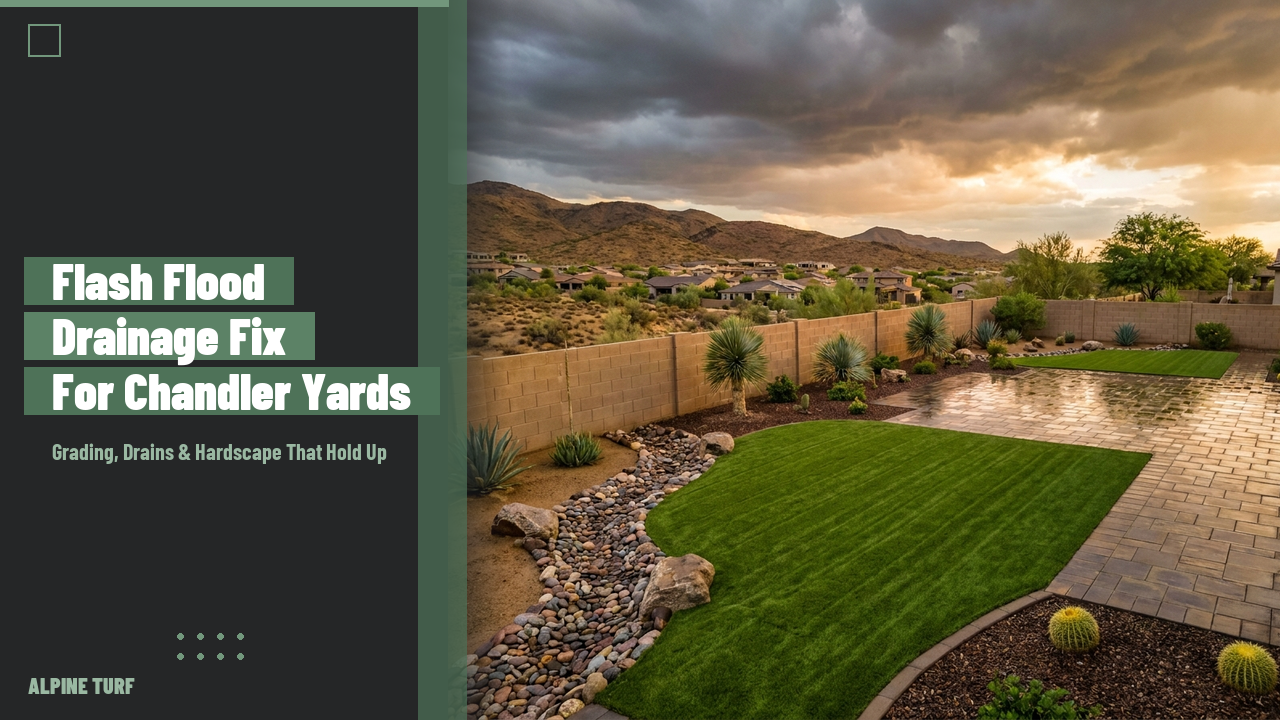
Flash Flood Drainage Backyard Chandler AZ: What Actually Stops It
Caliche soil and dead-flat East Valley lots turn a twenty-minute monsoon cell into standing water against your block wall. Here is the grading, drain, and hardscape fix that actually holds up season after season, not just until the next storm.
Every monsoon season, the same call comes in from Chandler homeowners: the backyard was fine an hour ago, and now there is four inches of water sitting against the block wall, the turf is floating at the low corner, and the water has nowhere to go. It is not bad luck. It is a design problem, and in most cases it was baked into the yard the day the builder graded the lot.
Chandler sits on some of the flattest ground in the East Valley, layered over caliche that barely absorbs water even when it is dry. When a monsoon cell parks over the Price Road corridor and drops real rain in a short window, a yard that was never properly graded does not have a chance. This guide walks through why Chandler backyards flood, what actually fixes it, what the city requires before you touch a shovel, and when the job needs an engineer instead of an installer.
Flash Flood Drainage Backyard Chandler AZ Problems: Why They Happen Here
Two things make Chandler backyards more flood-prone than a lot of their East Valley neighbors. The first is topography. Large stretches of the city, especially around the Price corridor and the older subdivisions south of Ray Road, sit on ground so flat that a quarter-inch of unintentional backward slope is enough to trap water against a foundation or a wall for hours instead of minutes.
The second is soil. Caliche, the hardpan calcium carbonate layer common across the East Valley, sits a foot or two below the surface on a lot of Chandler properties. It behaves almost like concrete once it is compacted — water does not soak through it, it sits on top of it and spreads sideways until it finds the lowest point in the yard. We cover the mechanics of that soil layer in more detail in our caliche landscaping guide for the East Valley, but the short version for drainage purposes is this: if your yard has caliche near the surface, you cannot dig a hole and expect it to drain on its own. It needs help.
Add new-construction grading into the mix and the problem compounds. Builders grade a lot to the minimum standard required to pass a final inspection, not to handle the strongest storm of the season. Planter beds get built up against the block wall after the fact, side yards get filled in unevenly by whoever poured the concrete, and within two or three years the original grade that used to shed water toward the street or an easement has been quietly erased by landscaping.
Grading Is the First Fix, Not the Last Resort
Before anyone talks about French drains or dry wells, we check the grade. A well-graded backyard should fall roughly 2% away from the house — about a quarter-inch of drop for every foot of distance — for at least the first ten feet off the foundation. On a lot of Chandler properties, that slope either never existed or has been flattened out over time by mulch, turf underlayment, or a patio poured without enough forethought.
Regrading is unglamorous work: strip the existing surface, cut and fill until the water has a clear, continuous path to a legal discharge point, then rebuild whatever sits on top. But it is the fix that makes every other drainage system actually work instead of just delaying the flood by twenty minutes. A French drain installed in a yard that still slopes back toward the house is fighting gravity. A French drain installed after the grade is corrected does the job it was designed for.
The most common mistake we see in Chandler backyards is a yard that drains fine toward the perimeter but has nowhere for that water to actually go once it gets there — a block wall on three sides with no weep holes, no swale, and no connection to the street or a legal drainage easement. Fixing the slope only matters if the water has somewhere to exit.
French Drains, Channel Drains, and Dry Wells: What Each One Actually Does
These three systems get lumped together constantly, but they solve different problems.
French drains are a gravel-filled trench with a perforated pipe at the bottom, wrapped in fabric to keep soil out. They are built for yards with a chronic wet strip — along a fence line, behind a retaining wall, or anywhere water collects below the surface and needs to be intercepted and carried somewhere useful. Installed correctly in the East Valley, expect to pay roughly $15 to $25 per linear foot, depending on trench depth and how much rock you are digging through.
Channel drains (also called trench drains) sit at the surface, usually a metal or plastic grate set into a patio, driveway, or the transition between hardscape and turf. They catch sheet flow before it reaches a doorway or a low point, which makes them the right call for paver patios and pool decks rather than open lawn areas.
Dry wells are underground gravel-and-chamber pits that let collected water percolate slowly into the surrounding soil instead of daylighting somewhere on the property. They make sense when there is no legal place to discharge water above ground — a landlocked backyard, for example, with walls on every side and no drainage easement. A residential dry well typically runs $2,500 to $5,500 installed, and Chandler will not sign off on one until it passes a percolation test confirming the soil around it can actually absorb the water fast enough to matter.
Most Chandler backyards we work on need a combination: grading to move water where it should go, a channel drain at the patio edge to catch what the hardscape sheds, and either a French drain or a dry well to handle the rest depending on whether there is a legal above-ground discharge point.
Hardscape and Turf That Work With Drainage Instead of Against It
Turf and pavers get blamed for flooding constantly, and it is almost never the material's fault — it is the base underneath it. A proper turf install uses a compacted, sloped crushed-granite base with a permeable geotextile layer, so water moves through the infill and base rather than pooling on top of a flat, compacted subgrade. Skip the base prep or lay turf directly over uneven native soil, and you have built a very green-looking bathtub.
Pavers have the same issue in reverse: a solid, low-permeability surface set on a poorly graded base sheds water fast, which is good, except that water has to go somewhere. That is why we design paver patios and turf areas together rather than as separate projects — the patio's runoff needs to land in a planned swale, channel drain, or turf area graded to accept it, not just sheet off toward whichever direction happens to be lowest that week.
This is also where full-scope planning pays off over a single-trade approach. A yard that gets turf from one company, pavers from another, and irrigation bolted on afterward usually ends up with three grading plans that do not agree with each other. Alpine Turf handles turf, pavers, plants, and irrigation as one project specifically so the grading, drainage, and hardscape decisions get made together instead of stacked on top of each other after the fact. Our guide to build order for pavers and turf covers how we sequence that work.
Chandler's Grading and Drainage Rules (and What Happens If You Skip Them)
The City of Chandler's Unified Development Manual is specific on one point that matters more than any other: site improvements cannot adversely redirect stormwater onto a neighboring property. That means regrading your own backyard to solve your flooding problem by pushing water over the fence is a code violation, not a workaround, and it is the single most common mistake we see from DIY drainage attempts.
A few other Chandler-specific rules worth knowing before you start:
- Dry wells require a percolation test before final inspection — the city wants proof the soil can actually absorb the water, not just a hole with gravel in it.
- Retaining walls over 4 feet and screen walls over 7 feet require a building permit and have to meet Chandler's building code, which matters if your drainage fix involves raising or lowering grade near a property-line wall.
- Larger regrading or civil work goes through Chandler's Civil Plan Review and Inspections process, which is a heavier lift than a typical backyard remodel and usually only comes into play on larger lots or new-construction sites.
Most residential drainage fixes — regrading, a French drain, a dry well sized for a typical backyard — do not trigger the full civil review process, but they do need to follow the grading and drainage standards in the City of Chandler Unified Development Manual. Skipping that step is how homeowners end up re-doing work a year later after a neighbor complaint or a failed resale inspection.
Which Chandler Areas See This the Most
Drainage problems are not evenly distributed across the city. The flattest stretches — the neighborhoods along and near the Price Road corridor, and older subdivisions south of Ray Road that were built before current grading standards tightened up — are where we get called out most often. Newer master-planned communities like Fulton Ranch and Ocotillo generally have better engineered common-area drainage, but individual backyards inside those communities can still hold water if the builder's original grade has been altered by landscaping, added hardscape, or a pool deck poured without accounting for where the runoff goes.
The pattern holds regardless of neighborhood: it is rarely one single cause. It is usually a flat lot, a caliche layer a foot down, and years of small landscaping decisions that each shaved a little bit off the original grade until the yard stopped draining the way it was designed to.
When to Call a Drainage Engineer vs. When Grading and Drains Are Enough
Most backyard flooding in Chandler is solvable with regrading plus the right combination of French drains, channel drains, or a dry well — work an experienced installer can design and execute without bringing in a civil engineer. A handful of situations genuinely need engineered plans:
- The yard backs up to a wash, retention basin, or floodplain-adjacent parcel where Maricopa County Flood Control District rules may apply.
- Water is entering the house itself, not just pooling in the yard — that is a foundation and grading problem that needs documented, stamped plans.
- The fix requires altering a shared drainage easement or affects how water leaves the lot onto a neighboring property or the street.
- The lot has more than a few feet of elevation change and needs retaining structures beyond what a standard permit covers.
If none of those apply, a properly designed grading and drainage plan from an experienced East Valley installer, submitted and approved through Chandler's standard permit process, is usually enough. The Maricopa County Flood Control District maintains real-time rainfall data across the Valley if you want to see how much rain your specific area actually received during a storm before deciding how aggressive the fix needs to be.
Frequently asked questions
How much does backyard drainage cost in Chandler AZ?
A regrading-only fix on a typical backyard runs a few thousand dollars. Add a French drain and you're usually looking at $15–$25 per linear foot on top of that, and a dry well adds $2,500–$5,500 depending on soil percolation. A full project that includes grading, drainage, and new turf or pavers on top typically starts around $8,000–$10,000 and scales with yard size and how much hardscape is involved.
Do I need a permit for a French drain or dry well in Chandler?
Dry wells need to pass a percolation test before Chandler will sign off on final inspection. Most standard French drains and regrading on an existing residential lot fall under routine permitting rather than full civil plan review, but any work that changes how water leaves your property still has to follow the city's grading and drainage standards.
Will regrading my yard affect my neighbor's property?
It shouldn't, and it legally can't. Chandler's development standards specifically prohibit redirecting stormwater onto a neighboring lot. A correctly designed drainage plan routes water to a legal discharge point — the street, an approved easement, or an on-site dry well — not over the fence.
Can I install turf if my yard already floods?
Not until the grading and drainage are fixed first. Turf installed over a flat or poorly draining subgrade will hold water at the low points regardless of how good the turf itself is. We always address grade and drainage before or during a turf install, never after.
How long does a full drainage fix take?
Regrading plus a French drain on a standard backyard usually takes 2–4 days. Adding a dry well, permeable pavers, or turf on top of the drainage work extends that to roughly a week for most residential lots, weather permitting — we don't pour or grade during active monsoon storms.
Does homeowner's insurance cover backyard flood damage?
Standard homeowner's policies generally don't cover flooding, including monsoon-related yard flooding, and separate flood insurance is uncommon for East Valley homes outside mapped floodplains. That's exactly why fixing the grading and drainage before it becomes a claim is the more reliable move.
Tired of watching your backyard flood every storm?
We handle grading, drainage, turf, pavers, and irrigation as one project across Chandler, Gilbert, Mesa, Queen Creek, and San Tan Valley. Free on-site drainage assessment, no obligation.
Book your free drainage assessment →