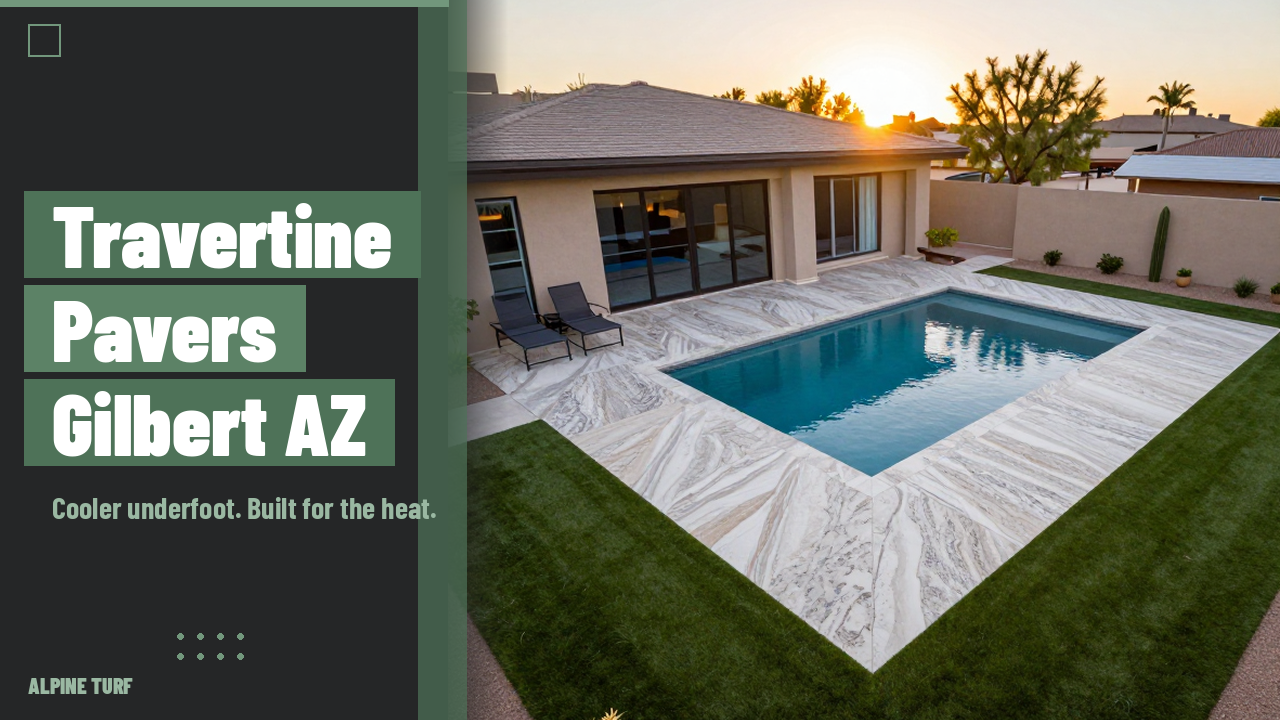
Travertine Pavers Gilbert AZ: Cost, Heat & Install Guide
The natural stone that stays cool underfoot around East Valley pools. Here is what travertine really costs installed in 2026, how it beats concrete in the heat, and how a proper install handles our caliche and clay.
By 2 p.m. in July, a poured-concrete patio in Gilbert can climb past 130°F, and dark stamped concrete runs hotter still. Walk it barefoot on the way to the pool and you understand why one material has taken over East Valley backyards. In fact, travertine pavers Gilbert AZ pool builders now install by default, because the stone stays markedly cooler underfoot, shrugs off UV without fading, and looks high-end the day it is set.
That said, travertine is not magic. A bad base will let it heave, an unsealed deck can stain, and the wrong grade shows filler holes within a season. Everything below is the numbers and trade-offs we actually walk homeowners through on-site, so you can price the job honestly and avoid the mistakes that turn a premium patio into a callback.
Why travertine owns the East Valley pool deck
Travertine is a natural sedimentary stone, quarried in slabs and cut into pavers. Two things make it the go-to hardscape around Gilbert pools. First is color: the ivory and silver blends most homeowners choose are genuinely light, so they reflect sunlight instead of soaking it up. Second is the stone itself, which does not conduct and hold heat the way a dense concrete slab does. Put those together and the surface temperature difference is something you feel through your feet, not just a spec sheet claim.
The look matters too. Travertine reads as custom and expensive the moment it goes down, with natural veining and a soft, tumbled edge that concrete can only imitate. In new-construction neighborhoods like Adora Trails, Layton Lakes, and Whitewing, it is the finish that makes a builder-grade backyard look designed. And unlike wood or stained concrete, it does not need refinishing every few years to keep that look.
There is a durability angle specific to our climate as well. Travertine's one real weakness in other regions is freeze-thaw damage, where water gets into the stone's natural pores, freezes, and spalls the surface. Gilbert simply does not get the sustained hard freezes that cause that, so a material that struggles in Denver quietly thrives here. If you want the full picture on sequencing hardscape with your lawn, our guide on whether to install pavers or turf first covers how the two trades fit together.
What travertine pavers Gilbert AZ homeowners actually pay in 2026
Pricing travertine has two parts: the stone and the install. Travertine paver material itself runs roughly $4–$9 per square foot depending on grade, color, and pattern. But material is the smaller number. What you are really paying for is excavation, base, and skilled labor, which is where a Gilbert install lands between $14 and $22 per square foot installed for a standard patio or walkway on a compacted aggregate base.
A few things move that number. Pool decks cost more than flat patios because they add coping, tie into existing pool structure, and often require mortar-setting over the pool beam. Small or oddly shaped areas cost more per foot because there is more cutting and less economy of scale. Demolition of an existing concrete slab adds a few dollars per square foot. And premium French-pattern (Versailles) layouts, which mix four tile sizes, cost more to lay than a simple running bond.
As a real-world anchor: a 400 sq ft travertine patio in Gilbert typically lands around $6,000–$8,500 turnkey, while a full 800 sq ft pool deck with coping is usually a $14,000–$20,000 project. For how a paver patio fits into a whole-yard budget, see our detailed Gilbert paver patio cost breakdown and the broader Gilbert backyard cost guide.
Travertine vs. concrete pavers vs. poured concrete
Most Gilbert homeowners are choosing between three surfaces. Here is the honest comparison we give on-site, with no thumb on the scale.
| Factor | Travertine pavers | Concrete pavers | Poured concrete |
|---|---|---|---|
| Surface heat (July) | Coolest (light stone) | Warm | Hottest, esp. stamped/dark |
| Look | Natural, high-end veining | Uniform, can look flat | Utilitarian unless stamped |
| Cracking in AZ soil | Flexes, individual units | Flexes, individual units | Cracks as soil moves |
| Color over time | Stable, no fade | Can fade / pigment out | Stable but stains |
| Repairability | Lift & replace one stone | Lift & replace one paver | Patch is always visible |
| Maintenance | Optional seal every 2–3 yr | Optional seal / sand joints | Low, but cracks worsen |
| Installed cost/sq ft | $14–$22 | $12–$18 | $8–$14 |
Poured concrete wins on upfront price and loses on almost everything that matters in the long run here, because our expansive clay soils move and eventually crack a monolithic slab. Concrete pavers are a solid middle option and slightly cheaper than travertine. Travertine costs the most upfront but delivers the coolest, most premium surface, which is why it is the near-automatic pick for pool decks where bare feet live all summer.
Picking the right travertine: color, grade, and finish
Not all travertine is equal, and the choices here directly affect both how cool the deck stays and how it ages.
Color
Ivory is the lightest and coolest, and the most popular for pool decks. Silver adds gray veining and hides dust a bit better. Walnut and Noce are warmer browns that look gorgeous but run hotter in direct sun, so we steer pool-deck clients toward the lighter blends and save the darker tones for shaded patios and accents.
Grade
Travertine is sold in grades. Premium or first-grade stone has fewer natural voids and tighter, more consistent color. Commercial or standard grade is cheaper but shows more filler holes that can open up over time, catch dirt, and become trip and chip points. For a visible pool deck, first-grade is worth the small premium. For a hidden side-yard walkway, standard grade can be a smart saving.
Finish and pattern
A tumbled finish gives soft, rounded edges and a matte, slip-resistant surface that suits pool decks. Sizes range from tidy 6x12 and 12x12 units to the four-piece French pattern that reads as one continuous, custom floor. Standard travertine pavers are about 1.25″ thick, which is part of why base prep and edge restraint matter so much.
How a proper travertine install goes in Gilbert soil
The difference between a travertine deck that lasts 30 years and one that heaves in three is entirely below the stone. Here is the sequence a real install follows.
- Excavation. Dig out 5–7″ for a patio (more for driveways) to make room for base and stone. This is also where existing concrete gets demoed and hauled.
- Soil handling. Gilbert's caliche and expansive clay are the whole game. Caliche is dug or broken out where it interferes with drainage, and the subgrade is compacted. A geotextile fabric goes down to separate soil from base and stop the two from mixing over time.
- Aggregate base. 4–6″ of road base (ABC) is laid and compacted in lifts, not all at once, so it actually reaches density. This is the load-bearing layer, and skimping here is the number-one cause of settling.
- Bedding and laying. A thin bedding layer is screeded flat, then the travertine is set in the chosen pattern with consistent joints. Around pools, the coping and any section over the pool beam is typically mortar-set for a locked, permanent edge.
- Edge restraint and joints. Solid edge restraints keep the field from spreading, and joints are filled (polymeric sand on dry-set fields) to lock units and limit weeds and ants.
- Seal and clean. The deck is cleaned and, if you want it, sealed with a penetrating sealer. Then a final pass confirms drainage runs away from the house and pool.
Base prep is exactly where cut-rate installers cut corners, because you cannot see it once the stone is down. Our guide to caliche and East Valley soil goes deeper on why this matters here specifically, and our backyard install timeline shows how these steps sequence across a real project.
Sealing, cleaning, and living with it for 15 years
Travertine is low-maintenance, not no-maintenance. Because it is a calcareous stone, it reacts to acids, so spilled margaritas, citrus, and some pool chemicals can etch an unsealed surface. For that reason we recommend a penetrating (not topical) sealer on pool decks and outdoor kitchens, reapplied every 2–3 years. Penetrating sealers protect against staining without making the surface slick or trapping heat, which is the whole point of choosing travertine.
Some homeowners deliberately leave patios unsealed for maximum coolness and traction, and accept that they will patina over time. Both are valid. Day to day, upkeep is a rinse with a hose and the occasional sweep. Skip high-pressure washing, which can blow out joint sand and open filler holes, and use a pH-neutral stone cleaner rather than acidic tile products. Handled this way, a quality travertine deck comfortably outlasts the pool equipment around it. One more tip specific to our dust: a quick rinse before big gatherings keeps the light ivory looking crisp, since fine desert dust is what dulls a pale stone long before any real wear does. And if a single unit ever chips from a dropped patio heater or a dragged grill, it lifts out and gets replaced individually, which is a repair a poured slab can never match.
HOA, permits, and drainage in Gilbert
Most residential travertine patios and pool decks in Gilbert do not require a permit when you are not altering drainage structures, adding roof cover, or building in an easement. Anything structural, or work near a public easement, can change that, so it is worth a quick check with the Town of Gilbert Development Services before a big project. For stone-care specifics, the Natural Stone Institute is a solid independent reference.
If your home is in an HOA community like Seville, Power Ranch, or Val Vista Lakes, hardscape changes visible from the street usually need architectural approval. Travertine is almost always welcomed because it reads as an upgrade, but you still want the paperwork done right. We handle that documentation as part of the job. The bigger technical issue in Gilbert is drainage: monsoon downpours have to move away from the house and pool, so grading and joint choice are planned around the storms, not just the sunny days.
Frequently asked questions
How much cooler is travertine than concrete in Arizona?
In direct summer sun, light ivory or silver travertine typically measures about 10–20°F cooler underfoot than tan concrete pavers, and dramatically cooler than dark or stamped concrete. The lighter the travertine, the bigger the difference, which is why we point pool-deck clients toward ivory rather than the warmer walnut tones.
Do travertine pavers need to be sealed in Gilbert?
Sealing is optional but recommended for pool decks and outdoor kitchens, where pool chemicals, sunscreen, and food acids can etch or stain the stone. A penetrating sealer every 2–3 years protects it without making it slick or hot. Patios away from a pool are often left unsealed for maximum coolness and traction.
Is travertine slippery around a pool?
Tumbled travertine, the finish we use on pool decks, has a naturally textured, matte surface that is slip-resistant when wet, which is a big reason it is the default pool-deck stone in Arizona. Avoid high-gloss topical sealers, which can reduce traction. A penetrating sealer keeps the natural grip intact.
How long does a travertine paver installation take?
A typical residential patio or pool deck runs about 3–6 working days depending on size, demolition, and whether coping is mortar-set. Excavation and base prep take the most time and are the most important stage. Weather, especially monsoon storms and extreme-heat days, can shift the schedule slightly.
Can travertine be installed over an existing concrete slab?
Yes. If your existing slab is sound and draining correctly, travertine can be mortar-set (overlaid) on top, which saves demolition cost. If the slab is cracked or heaving from soil movement, we usually recommend removing it and building a proper aggregate base, because an overlay only inherits the problems underneath it.
Does travertine work with artificial turf?
Extremely well, and it is one of the most popular combinations we install. A travertine deck framed by a clean turf border gives you a cool, low-glare hardscape and a soft, water-free lawn with no mud line between them. Both are planned together so the base heights and drainage line up. See our guide on the best turf for pool decks for pairing details.
Want a cooler pool deck?
We design and install travertine patios, pool decks, and turf combos across the East Valley — Gilbert, Chandler, Mesa, Queen Creek, and San Tan Valley. Free on-site measure and quote, no obligation.
Book your free quote →