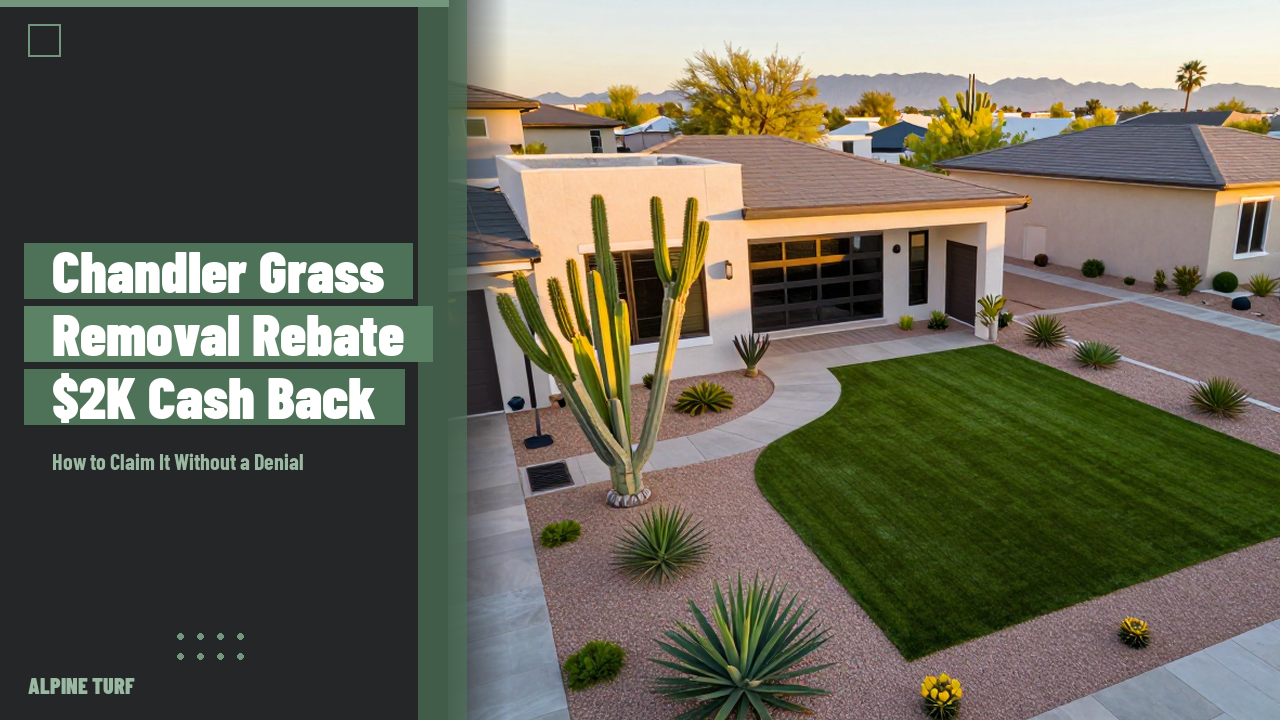
Chandler Grass Removal Rebate (2026): How to Get $2,000 Back
The City of Chandler pays homeowners $1.50 per square foot to remove live grass, up to $2,000 per property. Here is exactly how to qualify, the steps to apply, and the application mistakes that turn a $2,000 check into a denial letter.
If you live in Chandler and you are tired of watching $80 to $200 a month evaporate into the lawn during summer, the city will literally pay you to stop watering. The Chandler grass removal rebate pays $1.50 per square foot of live grass you take out, up to a maximum of $2,000 per single-family property. For a typical 1,200 to 1,500 square foot front yard conversion, that is the full $2,000 check back in your pocket, plus permanently lower water bills the day the grass is gone.
The catch is that the application is strict, and the city updated the program in January 2026 with lower payouts and tighter eligibility rules. Submit the paperwork in the wrong order, miss the pre-inspection, install the wrong replacement landscape, or pull from the wrong utility provider, and the rebate gets denied. This guide walks the program end to end: the exact 2026 rebate amounts, who qualifies, the step-by-step application process, what counts as a qualifying replacement landscape, and the most common reasons applications get rejected.
How much is the Chandler grass removal rebate in 2026?
The City of Chandler administers two grass-removal rebate programs: one for single-family residential and a larger one for multi-family, commercial, and HOA common areas. This guide focuses on the single-family residential program, which is what most Chandler homeowners need.
Effective January 1, 2026, the City of Chandler reduced the rebate from $2.00 per square foot to $1.50 per square foot, and dropped the maximum payout from $3,000 to $2,000. The new rates apply to any conversion finished after that date, even if the application was started under the old rules. Most Chandler residential lots hit the $2,000 cap by removing 1,334 square feet or more of grass.
Rebates are paid in 10 square foot increments rounded up to the nearest increment. A conversion of 1,247 square feet rounds up to 1,250 square feet, which at $1.50 pays $1,875. The increment math is small but matters if you are right at a threshold.
Unlike the City of Mesa program, Chandler does not currently have an SRP partnership match. The rebate is a single source from the City of Chandler. Tempe and a few other East Valley cities still stack SRP, but in 2026 Chandler is a city-only program.
Who qualifies for the Chandler rebate?
The 2026 program tightened the rules but the basics still cover most Chandler homeowners. Four conditions you have to meet.
- Chandler city water account. The property has to be served by City of Chandler water utility, not a private water company or a neighboring city's utility. Some homes inside Chandler city limits are on private water, especially on the south side. Check your water bill before applying.
- Live, irrigated grass on the property. The rebate covers conversion of real, currently irrigated turf grass. Bare dirt patches, dead lawn that has been off irrigation for months, decorative ornamental grass beds, and existing fake turf do not count.
- Minimum 500 square feet of grass to remove. Smaller patches do not qualify. You can combine front, side, and back yard areas to hit the threshold, as long as it is all on the same property.
- Single-family residential property. Duplexes, condos, HOA common areas, and commercial properties use a separate program with different payouts. The single-family program is built around an owner-occupied home or a single-family rental.
One subtle rule that catches some applicants: the program covers each property once. If a prior owner already claimed a rebate on the parcel, the new owner generally cannot reapply for the same patch of grass. Worth asking the city if you bought the home recently.
Step-by-step application process for the Chandler grass removal rebate
The order matters. Get this sequence wrong and a perfect conversion still gets the rebate denied. There are seven steps from initial application to receiving the check.
- Apply BEFORE removing any grass. Submit the application through the City of Chandler Single Family Grass Removal Rebate Program page. You will need photos of the existing grass, a sketch of the conversion area with measurements, and your water account number. Allow 7 to 10 business days for initial review.
- Pre-inspection visit. A Water Conservation Office inspector visits the property to confirm the live grass, measure the conversion area, and verify the proposed replacement landscape meets program rules. The inspector also flags any issues that would disqualify the application before you spend money on the conversion.
- Written approval to proceed. After pre-inspection, the city sends written approval that specifies the approved conversion area in square feet and any required adjustments to the replacement landscape plan. Do not start demo before you have this approval in hand.
- Finish the conversion. Remove the grass, install the new low-water landscape with approved plants, set up drip irrigation, and add any decorative gravel, pavers, or hardscape elements that are part of the plan. You typically have 12 months from approval to complete the work.
- Submit final documentation. The city wants photos of the completed landscape from multiple angles, copies of plant and material receipts, and an updated site sketch showing what was actually installed.
- Final inspection. A second inspector visit confirms the completed conversion matches the approved plan and meets all program requirements. Differences from the approved plan can reduce or eliminate the rebate.
- Receive your rebate check. Approved final inspections trigger payment, usually within 6 to 8 weeks. The check arrives by mail at the property address or the account holder address on file.
Total timeline from initial application to check in hand: typically 4 to 7 months for a residential conversion. The active install phase is only 2 to 4 weeks. The rest is paperwork, inspections, and city processing.
What counts as a qualifying replacement landscape?
This is the rule that catches most homeowners off guard. The City of Chandler does not pay you to replace grass with bare gravel. The new landscape has to be a real low-water landscape, defined by specific plant coverage and irrigation requirements.
Approved plant list. Chandler maintains a list of city-approved low-water plants that automatically qualify. Native and desert-adapted plants are the foundation: red yucca, brittlebush, desert spoon, sage, lantana, agave, fairy duster, ocotillo, and similar shrubs and ground covers. Approved trees include palo verde, mesquite, ironwood, desert willow, and acacia. Most ornamentals and tropical plants are off the list.
Drip irrigation required. The replacement landscape has to be on drip irrigation. Spray heads in the converted area trigger an automatic denial. If you keep grass somewhere else on the property, the spray system there has to be physically separated from the new drip zones with no overlap.
Plant coverage at maturity. The new landscape has to maintain meaningful live plant coverage at maturity, not just look like a real xeriscape on day one. The standard is that decorative gravel and hardscape together should not exceed roughly half the converted area when the plants reach mature size. Sparsely planted "gravel yards" do not pass final inspection.
No invasive species. Plants on Chandler's prohibited list (fountain grass, certain palms, oleander in some configurations) do not count toward plant coverage and can actually disqualify the application. Your installer should know the prohibited list cold.
Synthetic turf does not count as the replacement. The single-family grass removal program is built around real desert-friendly plants on drip irrigation. If you replace live grass with artificial turf, that area does not qualify for the rebate even though it does reduce water use. Mixed designs that include a clearly defined low-water plant zone meeting the 500 sq ft minimum can still earn the rebate on the qualifying portion.
The 5 most common reasons Chandler rebate applications get denied
After watching East Valley homeowners go through this process, the same mistakes show up over and over. Avoid these five and the rebate is almost guaranteed.
- Starting work before pre-inspection. Number one reason for denial across every East Valley rebate program. Once the grass is gone the inspector cannot verify what was there, and no verification means no rebate. No exceptions, no appeals.
- Replacement landscape is too gravel-heavy. Homeowners trying to save money by under-planting end up failing final inspection. The few hundred dollars saved on plants costs you the full $2,000 rebate. Budget the plants in from the start.
- Spray irrigation still active in the converted zone. Even a single forgotten spray head in the new low-water area triggers a denial. The full conversion to drip in the new zone is non-negotiable.
- Wrong water utility. Properties served by a private water company or a neighboring city utility do not qualify, even if they are inside Chandler city limits. Verify your water bill before spending design time on the application.
- Missing or unverifiable receipts. Final documentation requires receipts that account for the plants and materials installed. Cash purchases without paper trails or vague "landscape labor" line items get flagged. Keep itemized receipts for every plant, every irrigation component, and every yard of gravel.
The real cost math: rebate plus water savings
The rebate covers a meaningful chunk of a typical Chandler conversion, but the bigger long-term return comes from the water bill, which is permanent and starts the moment the grass is gone.
A 1,500 square foot patch of healthy fescue or rye grass in Chandler typically uses 70,000 to 90,000 gallons per year to stay green through Arizona summer. At 2026 Chandler water rates with tier-2 and tier-3 overages factored in, that runs $500 to $900 a year just for the water on that one section of yard. A converted low-water landscape on the same footprint uses 8,000 to 12,000 gallons per year, dropping the cost to roughly $60 to $120 a year.
Run the math on an $18,000 conversion of a 1,500 square foot front yard:
- Project cost: $18,000 for design, demo, hardscape, plants, drip irrigation, and lighting
- Rebate: $2,000 (1,500 sq ft hits the cap) reduces net cost to $16,000
- Annual water savings: $450 to $750 per year, plus you stop paying for gas, electric, and labor for mowers, edgers, and reseeding
- Payback period: 4 to 7 years on direct water savings alone, faster when factoring in maintenance time and lawn care
- Lifetime savings: over a 20-year holding period, the water-bill delta alone returns $9,000 to $15,000 to your pocket
The bigger Chandler conversions we have completed (1,800 to 2,500 sq ft of converted area on larger lots in Ocotillo, Fulton Ranch, and Sun Lakes) also pull home value forward. Chandler real estate listings with established desert landscaping consistently command stronger per-square-foot pricing than comparable homes still running thirsty grass, because buyers price in the water costs they would otherwise inherit.
What Alpine Turf handles on the rebate paperwork
Most Chandler installers will quote you a number and walk away from the rebate paperwork entirely. The homeowner is left to figure out the application, schedule the inspections, and assemble the final documentation alone. We handle it differently. Every Chandler grass-removal conversion Alpine Turf installs includes the rebate application managed end to end so the homeowner does not lose money to a missed step.
Specifically, our rebate-handling service includes:
- Confirming Chandler water utility eligibility before quoting the project
- Submitting the initial application with the city, including all required photos and measurements
- Coordinating the pre-inspection visit and being on-site to walk through the plan with the inspector
- Designing the replacement landscape to meet the plant-coverage and approved-plant rules with margin to spare
- Itemizing receipts and documentation throughout the install for the final submission
- Submitting the final paperwork once the project is complete
- Coordinating the final inspection and following up on the rebate check
For homeowners who would rather handle the paperwork themselves, we still hand off the qualifying-plant list, the final site sketch in the format Chandler wants, and the itemized receipts you need to submit. Either way, the goal is the same: a yard that meets every rebate rule and the maximum allowable check back in your pocket.
How to start your Chandler rebate this season
The Chandler rebate program runs on an annual budget cycle. Funds are allocated each fiscal year, which starts July 1. Applying in the spring or early summer puts you ahead of the rush and reduces the risk of running into a funding pause if the year's budget is exhausted before yours is processed.
Recommended sequence if you are starting from scratch:
- Walk your property and roughly measure your live grass area. If it adds up to 500 square feet or more across the property, you qualify on size.
- Pull your most recent City of Chandler water bill to confirm you are on city water.
- Book a free on-site consult with Alpine Turf. We measure exactly, sketch the qualifying replacement landscape, and quote the install with the $1.50/sq ft rebate factored in.
- Submit the city application before any work begins, then schedule the install once pre-inspection clears.
Most Chandler rebate-driven projects we handle are designed and installed within 4 to 8 weeks of the initial consult, plus the rebate paperwork timeline. Your check goes in the mail 6 to 8 weeks after final inspection.
Frequently asked questions
How much is the Chandler grass removal rebate?
In 2026 the City of Chandler pays $1.50 per square foot of live grass removed, up to a maximum of $2,000 per single-family property. The rates changed January 1, 2026 from $2.00 per sq ft (max $3,000) to $1.50 per sq ft (max $2,000). Rebates are paid in 10 square foot increments rounded up to the nearest increment.
Who qualifies for the Chandler rebate?
Single-family residential properties served by City of Chandler water utility qualify as long as the conversion removes at least 500 square feet of live, currently irrigated grass and replaces it with city-approved low-water landscaping on drip irrigation. The program covers each property once, so prior rebates on the same parcel can disqualify a new application.
Do I have to apply before removing the grass?
Yes. This is mandatory and the single biggest reason rebates are denied. The City of Chandler requires a pre-inspection to verify the existing grass before any conversion work begins. Once the grass is gone the inspector cannot verify what was there, and the application is rejected with no exceptions. Always submit the application and complete pre-inspection first, then start demo.
Can I just put down gravel after removing the grass?
No. The City of Chandler requires the replacement landscape to be a real low-water landscape with city-approved plants on drip irrigation. Pure gravel or rock-only yards do not qualify. The replacement has to include meaningful live plant coverage at maturity, drawn from the city's approved plant list.
Does artificial turf qualify as the replacement landscape?
Artificial turf alone does not qualify for the City of Chandler grass removal rebate. The program specifically requires the replacement to be a low-water landscape with city-approved plants on drip irrigation. Mixed designs that include a clearly defined plant zone meeting the 500 sq ft minimum can still earn the rebate on the qualifying portion, while the artificial turf portion would not count toward the rebate calculation.
How long until I get the rebate check?
Total timeline from initial application to check in hand is typically 4 to 7 months. The application review takes 7 to 10 business days, the install itself runs 2 to 4 weeks once approved, and after final inspection the rebate check arrives in 6 to 8 weeks. Submitting earlier in the city fiscal year (which starts July 1) reduces the risk of running into a funding pause if the year's budget gets exhausted.
Get your Chandler rebate-qualified xeriscape quote
We design and install rebate-qualifying grass-removal conversions across Chandler, Mesa, Queen Creek, Gilbert, and the rest of the East Valley. Free on-site consult, tiered quote, and we handle the rebate paperwork end to end.
Book your free quote →