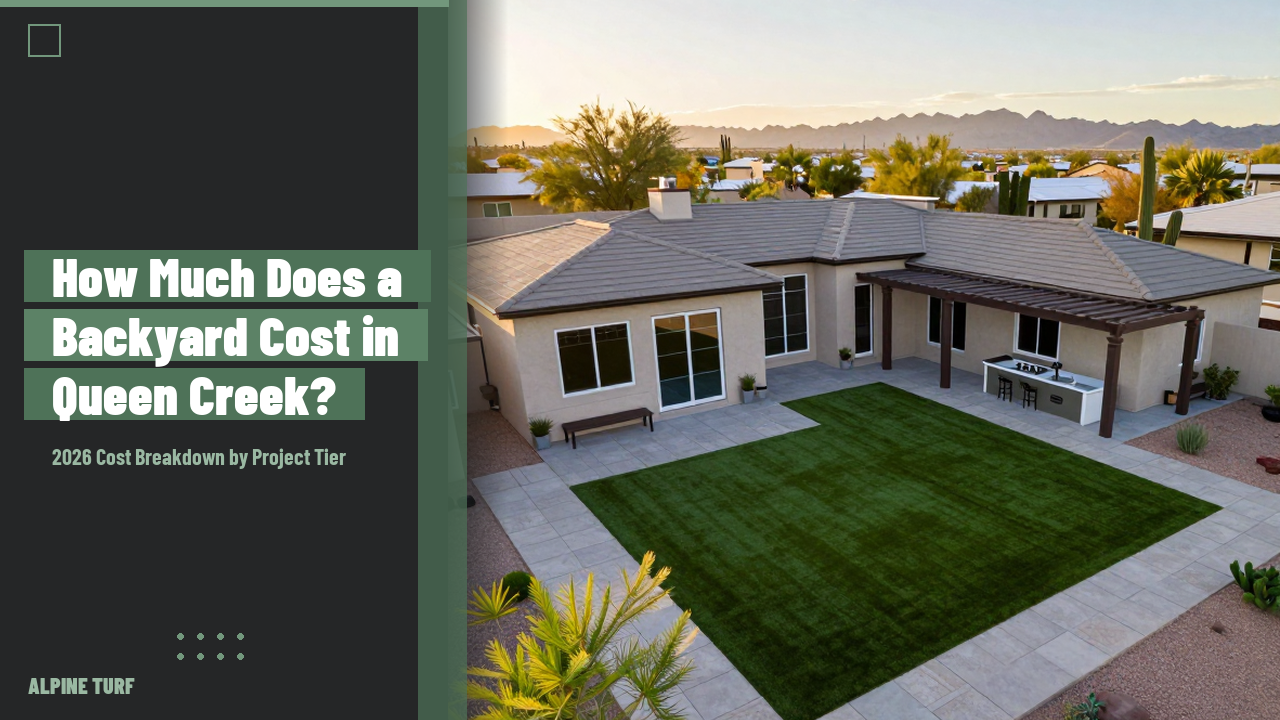
How Much Does a Backyard Cost in Queen Creek? (2026 Guide)
Real 2026 pricing by project tier — turf, pavers, plants, outdoor living. What drives the number up, what you can cut without regrets, and the actual timeline from dirt to done.
If you've been getting quotes for a backyard in Queen Creek, you've probably seen numbers all over the map — one company says $7,000, the next says $62,000, and a third just hands you a vague "it depends" before disappearing. Both can be right. The final price depends almost entirely on what you're putting in the yard, what's already in the ground, and how complete you want the result to be.
This guide breaks down real 2026 pricing the way we explain it on-site to homeowners across the East Valley — by tier, by what's actually included, and by the surprises that quietly add $5,000–$15,000 to a quote no one warned you about. By the end you'll know exactly which tier fits your space, your budget, and your timeline.
How much does a backyard cost in Queen Creek? The honest answer
Across the projects we've installed in the East Valley over the last twelve months, full backyard transformations break cleanly into three tiers. These ranges include materials, labor, design, permits where required, and the warranty. They don't include pools — those are a separate trade and a separate budget.
Most homeowners we work with land in Tier 2. New-construction homes (think Hastings Farms, Spur Crossing, Encanterra, Ovation, Meridian) tend to skew toward Tier 2 or Tier 3 because there's nothing in the yard yet — it's all dirt. Resale homes that already have a patio and working irrigation often start with a Tier 1 refresh and grow from there.
Tier 1: Refresh — $5,000 to $15,000
The Refresh is the smallest meaningful project we run. It's right for homeowners who already have a usable yard with basic infrastructure (a builder patio, working irrigation, some plants) and just want it to look intentional rather than neglected. We see this most in resale homes whose owners have been there 5+ years and want the space refreshed without a full remodel.
What's typically included at this tier:
- 300–700 sq ft of artificial turf with crushed-granite base and standard infill
- Decorative rock refresh, fresh weed barrier, and 5–10 desert-friendly plants
- Drip irrigation tune-up, leak fixes, timer replacement
- Low-voltage path or accent lighting (2–6 fixtures)
- Optional small paver upgrade — a stepping-stone path or 100–200 sq ft entry pad
Timeline: 1–2 weeks from contract to final walk-through. Most Tier 1 jobs are 3–5 working days on-site.
Tier 2: Full Family Backyard — $15,000 to $40,000
This is where most Queen Creek backyards land — and where the cost-per-square-foot math gets interesting, because every zone you add (fire pit, pergola, putting green, dog run) adds both materials and labor but also adds usable square footage that bumps the home's resale value.
What's typically included:
- 800–1,500 sq ft of premium artificial turf with cooling infill (Envirofill or HydroChill)
- 400–800 sq ft of paver patio in concrete, travertine, or porcelain pavers
- A pergola or shade structure (10×12 to 12×16) with optional fans and power
- Built-in fire pit or gas fire feature
- 15–25 desert-adapted plants and 1–2 specimen trees
- Smart drip irrigation with separate zones for plants vs. trees
- Comprehensive low-voltage lighting throughout
- Drainage solutions for monsoon season — the part most builders skip
Timeline: 3–5 weeks. Hardscape and irrigation usually run concurrently after grading is locked in. Pergolas and structures often have a 2–3 week lead time on materials.
Tier 3: Custom Outdoor Living — $40,000 to $100,000+
Tier 3 is a full outdoor living build — a true second home outdoors. It's appropriate for larger lots (1/3 acre+, common in newer Queen Creek developments), homeowners who entertain regularly, or anyone who plans to stay in the home long enough to enjoy the upgrade for a decade or more.
What's typically included:
- Full outdoor kitchen with built-in grill, refrigeration, sink, and stone countertops ($15K–$30K of the budget on its own)
- 2,000+ sq ft of premium turf zones — main lawn, dog run, putting green
- 1,000+ sq ft of designer hardscape — travertine, porcelain, or natural flagstone
- Custom-built pergola or full-roof ramada with electric, fans, lighting, and TV provisions
- Water feature, fire feature, or both
- 30+ designer plants, multiple specimen trees, large container arrangements
- Architectural landscape lighting, smart-home irrigation, and integrated audio if requested
Timeline: 5–8 weeks. These projects usually involve a permit pull for the kitchen's gas and electric, plus longer material lead times for stone and custom shade structures.
What actually drives the cost in Queen Creek
The number on your quote isn't decided by the materials list — it's decided by what's underneath them. Here's where the real money goes on a Queen Creek backyard, in rough order of impact:
- Grading and drainage. Queen Creek soil is a mix of clay and caliche, and a lot of newer subdivisions were rough-graded to drain toward the back of the lot. Fixing slope and adding French drains or sub-surface emitters is often the difference between a yard that survives monsoon and one that pools every July.
- Base preparation. Whether it's pavers or turf, the base is the entire game. A 4-inch compacted crushed-granite base under turf adds $1.50–$3.00 per square foot but is the only reason your install lasts 15 years instead of 5.
- Square footage. Bigger yards aren't proportionally cheaper — they need more prep, more material, and longer crew days, but per-square-foot pricing does come down on larger jobs as fixed costs (mobilization, design, equipment) get spread out.
- Material upgrades. Travertine vs. concrete pavers is roughly +$5–$8/sq ft. HydroChill cooling infill vs. silica sand is +$2/sq ft on turf. A custom-fabricated steel pergola vs. an off-the-shelf wood kit can swing $3,000–$8,000.
- HOA and design constraints. Some Queen Creek HOAs (Encanterra and parts of Cortina especially) require design submittals, color-matched stone, and approved plant palettes. That adds design time and sometimes restricts the cheaper options.
New construction vs. existing yard remodel
If you bought a new construction home in Queen Creek, your "backyard" right now is probably a flat dirt rectangle with a hose bib and maybe a builder-grade concrete patio. That's not necessarily a bad thing — you have a blank slate with no demolition costs — but it does mean your number is going to start higher than a remodel because you're paying for everything from grade up.
Realistically, $20,000 is the floor for making a new-build yard genuinely usable: turf, a real patio extension, irrigation, a few trees for shade, and the plants required to meet your HOA's canopy density rules. Anything below that and you're either staying very small or skipping critical infrastructure (drainage, irrigation) you'll regret in a year.
Existing backyards being remodeled have demo and haul-away costs ($1,500–$5,000 depending on what's coming out) but you're often inheriting working irrigation, established trees you can keep, and an existing patio you can extend rather than build from scratch.
Permits, HOAs, and Queen Creek's turf rules
The good news: the Town of Queen Creek does not require a permit for residential landscaping in most cases. You only need a permit when you're running new gas or electric (think outdoor kitchen), building a roofed structure attached to the house, or altering drainage in a way that affects a neighbor's property.
Two specific Queen Creek rules to know:
- The 1,000 sq ft turf cap. Within Town of Queen Creek limits, residential lots can have up to 1,000 sq ft of artificial turf. Front and back are calculated separately. If your dream yard wants more turf than that, you'll either need to design around it (pavers + turf zones) or be on a property in San Tan Valley or unincorporated county where the rule doesn't apply.
- 30% plant canopy density. Total landscaped area still has to maintain 30% live plant canopy at maturity. This is why turf-only yards aren't really an option in Queen Creek — you need plants and trees factored into the design.
For HOA approval, allow 2–4 weeks. The bigger Queen Creek HOAs review packets monthly. We provide the plan drawings and material samples needed for the submission as part of every Tier 2 and Tier 3 project.
Where to save (and where you really shouldn't)
Some line items on a backyard quote are genuinely flexible — others look like savings now and become expensive problems later. Here's the honest cut.
| Line item | Safe to cut? | Reasoning |
|---|---|---|
| Designer plants vs. nursery basics | Yes | Plants establish in 1–2 years; you can upgrade later as budget allows. |
| Pergola material (steel vs. wood) | Yes | A well-built wood pergola lasts 15+ years in AZ if sealed properly. |
| Patio square footage | Yes | Easier to extend later than to oversize now and never use it. |
| Travertine vs. concrete pavers | Yes | Concrete pavers look great and save $5–$8/sq ft. Travertine is luxury, not necessity. |
| Turf base prep depth | No | Skipping the base is the #1 reason turf fails early. Saves $1.50/sq ft today, costs you the whole install in 3 years. |
| Drainage and grading | No | One bad monsoon and you'll be redoing pavers or replacing turf. This is non-negotiable in Queen Creek. |
| Irrigation (drip vs. nothing) | No | Hand-watering 25 plants in 110° heat is not realistic. Plants will die without drip. |
| Lighting infrastructure | No | Wiring conduits during install is cheap; pulling them after pavers are down means tearing pavers up. |
The cleanest way to save money on a Queen Creek backyard is not to cut quality — it's to phase the project. Lock in the bones (grading, drainage, hardscape footprint, irrigation, base prep) in year one. Add the cosmetic and luxury items (specimen plants, custom shade, water features, outdoor kitchen) in year two when budget refreshes. We design plenty of phase-one builds with conduit and stub-outs already in place for phase two.
How to set a realistic budget for your specific yard
Before you call any installer, answer these three questions for yourself:
- Square footage. Walk the yard and pace it off, or pull up the Maricopa County Assessor's site for your lot dimensions. A typical Queen Creek backyard is 1,200–2,500 sq ft.
- Zones. List how many distinct "zones" you want — main lawn, patio, dining, fire/firepit, dog run, putting green, outdoor cooking, etc. Each zone is roughly $4,000–$15,000 depending on scope.
- Anchor feature. Pick one anchor — pergola, outdoor kitchen, fire feature, or specimen tree — that the design revolves around. This is where the personality lives.
Once you have those three answers, our team can usually quote within 10% on a 20-minute site visit. For a precise scope, plan on a one-hour design consult. We bring product samples, walk the yard with you, and follow up with a tiered quote so you can see exactly what each phase or upgrade costs.
Frequently asked questions
What's the average price of a Queen Creek backyard install?
Pricing in 2026 ranges from about $5,000 for a small refresh to $100,000+ for a full custom outdoor living build. Most family backyards land in the $15,000–$40,000 range with turf, pavers, plants, irrigation, and a shade structure. Final pricing varies with square footage, soil and grading, and material selection — travertine vs. concrete pavers alone can swing per-square-foot pricing by $5–$8.
How long does it take to install a backyard in Queen Creek?
A starter refresh takes 2–3 weeks from contract to walk-through. A full family-tier backyard runs 3–5 weeks, and a custom outdoor living build with kitchen and structures runs 5–8 weeks. The active install phase is shorter — most of the timeline is design, HOA review, and material lead times.
Do I need a permit to landscape my backyard in Queen Creek?
No permit is required for standard landscaping in Queen Creek — turf, pavers, plants, irrigation, and lighting are all permit-free. Permits are only needed when running new gas or electric (outdoor kitchens, attached ramadas) or altering drainage in a way that affects neighboring properties. HOA approval is a separate process and typically takes 2–4 weeks.
How much turf can I have in a Queen Creek backyard?
Within Town of Queen Creek limits, residential lots are capped at 1,000 square feet of artificial turf — calculated separately for front and back yards. The total landscaped area must also maintain 30% plant canopy density at maturity. Properties in San Tan Valley and unincorporated Maricopa County aren't bound by this rule.
Why does a new-build backyard cost more than a remodel?
New construction yards start as flat dirt with no grading, no irrigation, no plants, and only a builder-grade slab patio. You're paying for everything from the ground up, where a remodel often inherits working irrigation, established trees, and an existing patio. Plan on $20,000 minimum to make a new-build Queen Creek backyard genuinely usable, including the plants required to meet HOA canopy density rules.
Can I phase my backyard to spread out the cost?
Yes — phasing is one of the smartest ways to manage a backyard budget in Queen Creek. We design the full vision up front, then build the bones (grading, drainage, hardscape footprint, irrigation, base prep, conduit stub-outs) in phase one, and add the visual upgrades (specimen plants, custom shade, water features, outdoor kitchen) in phase two. Wiring and plumbing run during phase one means no tearing up pavers later.
Get your Queen Creek backyard quote
We design and install full backyards across Queen Creek, San Tan Valley, Gilbert, Chandler, and Mesa — turf, pavers, plants, irrigation, lighting, outdoor kitchens, the works. Free on-site consult and tiered quote, no obligation.
Book your free quote →