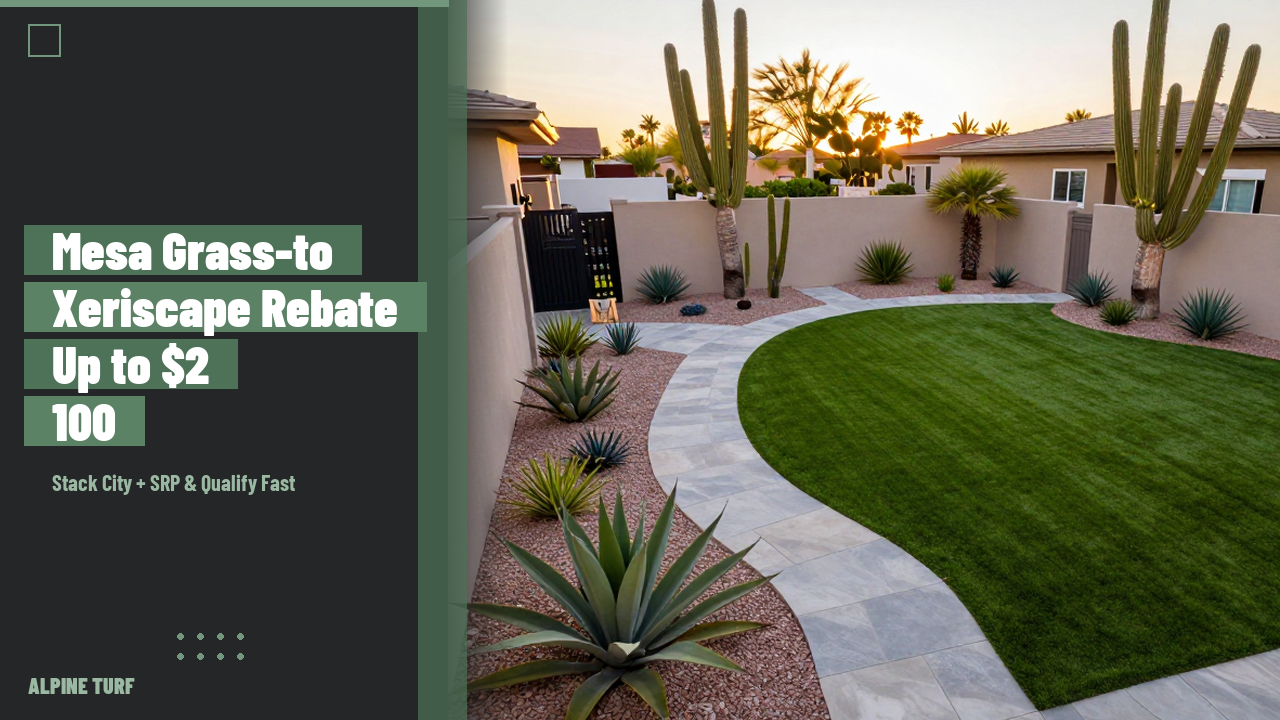
Mesa Grass to Xeriscape Rebate (2026): How to Get Up to $2,100 Back
The City of Mesa and SRP both pay you to convert live grass to desert-friendly landscaping. Here is exactly how much you can stack, what qualifies, and how to avoid the application mistakes that get most submissions denied.
If you live in Mesa and you are sick of paying $80, $120, or $200 a month to keep a patch of grass alive in 115-degree heat, the city literally wants to pay you to stop. Between the City of Mesa Grass-to-Xeriscape program and the SRP partnership match, Mesa homeowners can stack up to $2,100 in rebates for converting live lawn into desert-friendly landscape in 2026. That is real cash back, paid by check after the conversion is done.
The catch is that the application process trips up a surprising number of homeowners. Submit the paperwork in the wrong order, miss the pre-inspection, install a yard that does not meet the plant-coverage rules, or pick a non-qualifying water provider, and the rebate gets denied. This guide walks through the Mesa grass to xeriscape rebate end to end: how much you actually qualify for, what the city looks for in a qualifying landscape, the exact step-by-step application timeline, and the most common reasons applications get rejected.
How much is the Mesa grass to xeriscape rebate in 2026?
There are two stackable rebate programs available to Mesa residents who convert live grass to xeriscape. Both reward bigger conversions with bigger checks, and they pay separately for tree plantings on top of the grass conversion.
City of Mesa Grass-to-Xeriscape program: the city pays $750 for converting 500 to 999 square feet of live grass and $1,000 for converting 1,000 square feet or more. On top of that, the "Trees Are Cool" bonus adds $50 to $100 per qualifying low-water tree planted in the converted area, capped at $100 total. Most residential conversions max out the city portion at $1,100.
SRP partnership match: in 2024 SRP partnered with the City of Mesa specifically to expand the rebate for SRP electric customers who live inside Mesa city limits. SRP provides up to a $1,000 additional match on top of the city rebate. You have to be an SRP residential electric customer at the same Mesa service address as the converted yard. APS customers in Mesa do not get the SRP portion.
Combined, an SRP customer in Mesa converting at least 1,000 square feet of grass and planting one or two qualifying trees can collect up to $2,100 in rebates. For an average $15,000 to $20,000 full-yard conversion, that is roughly 10 to 14 percent of the project cost paid back in cash.
Who actually qualifies for the rebate?
The eligibility rules are written narrowly to keep cheaters out, but most ordinary Mesa homeowners qualify if they pay attention to four things.
- Mesa city water account. The property must be served by the City of Mesa water utility. If you are inside Mesa city limits but on a private water company, you do not qualify. Roughly 95 percent of single-family Mesa homes are on city water; check your utility bill if you are unsure.
- Existing live grass. The conversion must replace live, irrigated grass. Bare dirt, gravel that already exists, dead lawn that has not been irrigated in months, or fake/synthetic grass do not qualify. The pre-inspection confirms there is real grass to remove.
- Minimum 500 square feet. The smallest qualifying conversion is 500 square feet. Smaller patches do not get a rebate. Front yards, back yards, and side yards can be combined to hit the threshold across one application.
- Single-family residential. The base program is built for single-family homes. HOA-controlled common-area conversions go through a different commercial track. Multi-family rentals have a separate rebate structure.
SRP customers also need to be the residential electric account holder at the same property. Renters generally cannot apply directly; the property owner has to be on both the water account and the SRP account.
Step-by-step application process for the Mesa grass to xeriscape rebate
This is where most applications fall apart. The order matters and the timing matters. Skip a step or do them out of sequence and the rebate will not be paid even if everything else is perfect.
- Apply BEFORE removing any grass. Submit the online application through the City of Mesa Residential Grass-to-Xeriscape program page. You will need photos of the existing grass, a rough sketch of the area, and your water account number. Allow 5 to 10 business days for review.
- Pre-inspection. A city inspector visits the property to verify the grass exists, measures the area, and confirms the proposed plan meets program rules. This visit is mandatory. After approval you receive written permission to proceed. Do not start demo before this step is complete.
- Plan your replacement landscape. The new design has to meet plant-coverage and irrigation rules (covered in the next section). Most homeowners use this window to finalize the design with their installer.
- Complete the conversion. Remove the grass, install the new xeriscape, set up drip irrigation, plant the trees and shrubs, and lay any decorative gravel or pavers. You typically have 6 to 12 months to finish from the date of approval, depending on the program cycle.
- Submit final documentation. Photos of the completed landscape, copies of receipts for plants and materials, and a final site sketch. SRP customers also submit a separate SRP rebate form referencing the Mesa application number.
- Final inspection. A second city inspector visit confirms the conversion matches what was approved and meets all program rules.
- Receive your check. Approved applications get paid by mailed check, typically within 4 to 8 weeks of final inspection. SRP rebates are paid separately by SRP and arrive on a slightly different timeline.
Total timeline from initial application to receiving the check: usually 4 to 8 months for a typical residential conversion, though the active install phase only takes 2 to 4 weeks.
What counts as a qualifying replacement landscape?
This is the rule that surprises most homeowners. The City of Mesa does not pay you to replace grass with bare gravel. The replacement landscape has to be a real xeriscape, defined by specific plant-coverage and irrigation requirements.
Plant coverage at maturity. The converted area has to maintain a minimum of 50 percent live plant coverage at the maturity of the plants. That means desert-friendly shrubs, ground cover, and trees, sized so that when fully grown they shade or cover at least half the converted square footage. A landscape that is 90 percent decorative rock with five token cactuses will fail.
Approved plant list. The city maintains a low-water plant list that automatically qualifies. Native AZ shrubs (red yucca, desert spoon, brittlebush, sage, agave, lantana, fairy duster) and desert trees (palo verde, mesquite, ironwood, desert willow, acacia) all count. Most ornamental grasses and tropical plants do not.
Drip irrigation required. The new landscape has to be on drip irrigation, not spray heads. Sprinkler systems on the converted area disqualify the project. If you keep grass in another part of the yard, the spray system there has to be physically separated from the new drip zones.
No invasive species. Plants on the city's prohibited list (fountain grass, certain palms, oleander in some zones) do not count toward your plant coverage and can disqualify the application. Your installer should know the list cold.
Decorative materials are allowed but limited. Pavers, flagstone, decorative gravel, and stepping stones can fill the non-plant portions of the conversion area, but they cannot exceed 50 percent of the total area at plant maturity. Hardscape patios that were already there before the conversion do not count toward the new conversion area either way.
The 5 most common reasons applications get denied
After watching dozens of Mesa homeowners go through this process, the same handful of mistakes show up over and over. Avoid these and you almost certainly get paid.
- Starting work before pre-inspection. The single biggest reason for denial. Once the grass is gone the inspector cannot verify what was there. No verification means no rebate, no exceptions.
- Replacement landscape fails the 50 percent plant coverage rule. Most often this happens when homeowners try to do gravel-only yards or under-plant to save money. Going light on plants saves a few hundred dollars and costs you the entire $2,100 rebate.
- Water spray heads still active in the converted zone. Even one spray head in the new xeriscape area triggers a denial. The install has to fully convert that zone to drip.
- Wrong utility provider. Properties served by a private water company instead of City of Mesa do not qualify, and SRP customers in APS service areas do not get the SRP portion. Check your bills before applying, not after.
- Missing receipts or photos. The final documentation requires receipts for plants and materials totaling roughly the rebate amount. Cash purchases without paper trails get rejected. Keep every receipt.
The real cost math: rebate plus water savings
The rebate alone covers 10 to 14 percent of a typical Mesa front-yard conversion. The bigger payback comes from the water bill, which is permanent and starts the day the grass is gone.
A 1,000 square foot patch of healthy fescue or rye grass in Mesa needs roughly 50,000 gallons of irrigation water per year to stay alive in summer. At 2026 Mesa water rates with tier-2 overages factored in, that runs $400 to $700 a year just for the water on that one patch. A converted xeriscape on the same footprint uses 5,000 to 8,000 gallons per year, dropping the cost to $40 to $80.
Run the math on a $15,000 conversion of a 1,200 square foot front yard:
- Project cost: $15,000 to $18,000 for design, demo, hardscape, plants, drip irrigation, and lighting
- Rebates: $2,100 ($1,100 City of Mesa + $1,000 SRP) reduces net cost to $13,000 to $16,000
- Annual water savings: $400 to $600 per year, plus reduced gas/electric for not running mowers and edgers
- Payback period: 4 to 7 years on water savings alone, faster if you factor in the time you stop spending on lawn maintenance
- Lifetime savings: over 20 years, the water-bill delta alone is $8,000 to $12,000 in your pocket
The xeriscape also pulls home value forward. Mesa real-estate listings with established desert landscaping consistently command higher per-square-foot prices than similar homes still running thirsty grass, especially as buyers price in the future water costs they would inherit.
What Alpine Turf handles for the rebate paperwork
Most installers in the East Valley will quote you a number and walk away from the rebate paperwork entirely. We do the opposite. As part of every Mesa grass-to-xeriscape conversion we install, Alpine Turf manages the rebate application end to end so the homeowner does not lose money to a missed step.
Specifically, our rebate-handling service includes:
- Confirming Mesa water utility eligibility and SRP electric eligibility before quoting the project
- Submitting the initial application with the city, including required photos and area sketches
- Coordinating the pre-inspection visit and being on-site to answer the inspector's questions
- Designing the replacement landscape to meet the 50 percent plant coverage rule with margin to spare
- Tracking receipts and documentation throughout the install
- Submitting the final paperwork (city + SRP, where applicable) once the project is complete
- Coordinating the final inspection and following up on the rebate check
For homeowners who would rather handle the paperwork themselves, we still provide all the documentation, the qualifying-plant list, and the final site sketch in the format the city wants. Either way, the goal is the same: a yard that meets the rebate rules with no surprises and the maximum rebate amount in your pocket.
How to get started on your Mesa rebate this season
The grass-to-xeriscape rebate program runs on an annual budget cycle. Funds are allocated each fiscal year and the program does occasionally pause when the year's budget is exhausted. Applying earlier in the year (especially January through April) reduces the risk of running into a temporary funding pause.
Recommended sequence if you are starting from scratch:
- Walk your property and pace off the live-grass area. If it is at least 500 square feet, you qualify on size.
- Pull up your most recent City of Mesa water bill and your SRP electric bill to confirm both accounts.
- Book a free on-site design consult with Alpine Turf. We measure exactly, sketch the qualifying replacement landscape, and quote the install with the rebate factored in.
- Submit the city application before any work begins, then schedule the install once pre-inspection clears.
Most Mesa rebate-driven projects we run are designed and installed within 4 to 8 weeks of the initial consult, plus the rebate paperwork timeline. Check goes in the mail 4 to 8 weeks after final inspection.
Frequently asked questions
How much is the Mesa grass to xeriscape rebate?
In 2026 Mesa homeowners can stack up to $2,100 in rebates: up to $1,100 from the City of Mesa Grass-to-Xeriscape program ($1,000 for converting 1,000+ sq ft of grass plus up to $100 for qualifying trees) and up to $1,000 more from the SRP partnership match for SRP electric customers. Smaller conversions of 500 to 999 sq ft get $750 from the city instead of $1,000.
Who qualifies for the Mesa rebate?
Single-family residential properties served by the City of Mesa water utility qualify for the city rebate, as long as the conversion replaces at least 500 sq ft of live, irrigated grass. To get the SRP match on top, the property has to be served by SRP residential electric at the same address. Renters generally cannot apply directly; the property owner has to be on both accounts.
Do I have to apply before removing my grass?
Yes, this is mandatory and the single biggest reason rebates get denied. The City of Mesa requires a pre-inspection to verify the existing grass before any conversion work begins. Once the grass is gone the inspector cannot verify what was there, and the application is rejected with no exceptions. Always submit the application and complete pre-inspection first, then start demo.
Can I just put down decorative gravel after removing the grass?
No. The City of Mesa requires the replacement landscape to maintain at least 50 percent live plant coverage at plant maturity. Pure rock or gravel yards do not qualify. The rebate is specifically for converting to a real desert-friendly landscape, which means desert shrubs, ground cover, and trees from the city's approved low-water plant list, with drip irrigation in place.
How long until I get the rebate check?
Total timeline from initial application to receiving the check is typically 4 to 8 months for a residential conversion. The application review takes 5 to 10 business days, the install itself runs 2 to 4 weeks, and after final inspection the city check arrives in 4 to 8 weeks. SRP rebate checks come separately on a slightly different timeline.
Does artificial turf qualify for the Mesa grass to xeriscape rebate?
Artificial turf does not qualify as the replacement landscape for the City of Mesa grass-to-xeriscape rebate. The program specifically requires a real xeriscape with at least 50 percent live plant coverage. However, mixed designs that combine a smaller turf area with a separately defined xeriscape conversion zone can still earn the rebate on the xeriscape portion, as long as the conversion area on its own meets the 500 sq ft minimum and 50 percent plant coverage rule.
Get your Mesa rebate-qualified xeriscape quote
We design and install rebate-qualifying grass-to-xeriscape conversions across Mesa, Queen Creek, Gilbert, Chandler, and the rest of the East Valley. Free on-site consult, tiered quote, and we handle the rebate paperwork end to end.
Book your free quote →