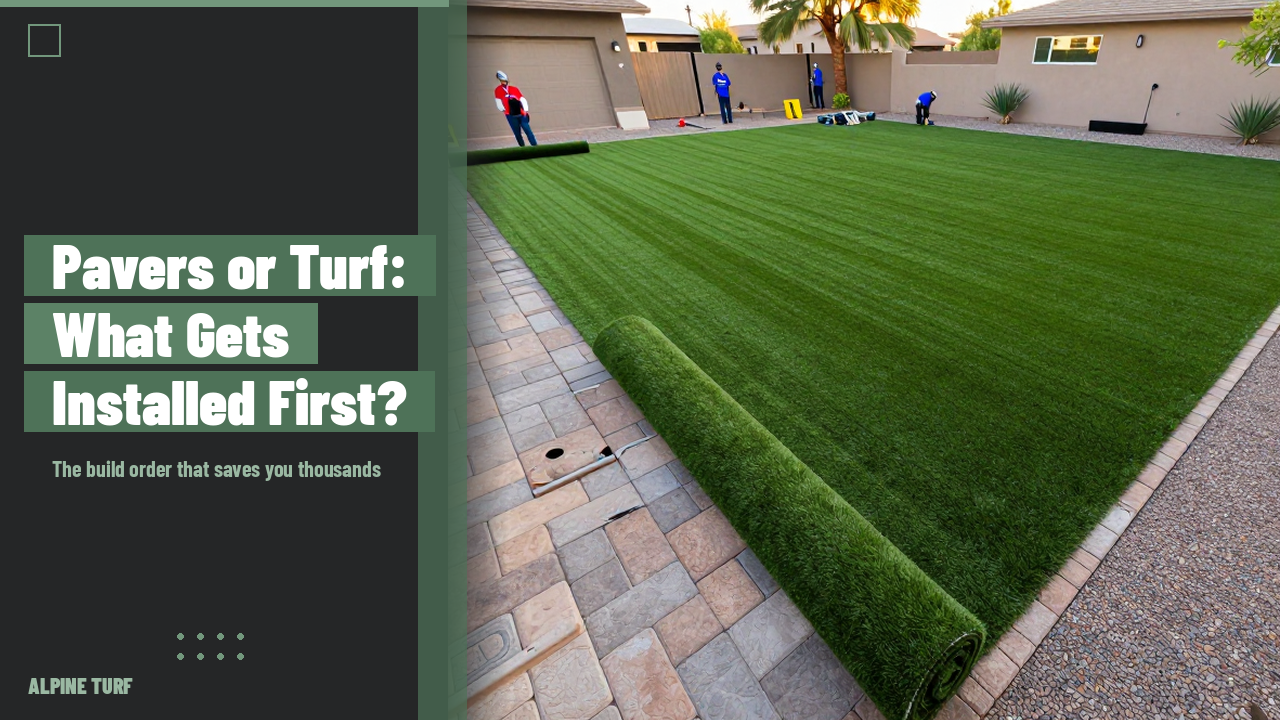
Pavers or Turf First? The Right Arizona Backyard Build Order
Every week we meet a homeowner who did the yard in the wrong order and paid twice for the privilege. Here is the exact sequence a professional Arizona backyard gets built in, and why each step sits where it does.
Short answer, since this is the exact question you searched: pavers or turf first has one professional answer, and it is pavers first, turf last. Hardscape is structure. Turf is finish. Structure gets built before finish, in backyards the same as in houses.
The longer answer is worth five minutes of your time, because the order the whole yard gets built in (not just these two materials) is the difference between a backyard that looks sharp for fifteen years and one that gets partially torn up in year two. We install turf-and-paver backyards across the East Valley every week, and out-of-order sequencing is the single most common and most expensive mistake we get called to fix.
Pavers or turf first: why hardscape wins
Three reasons, all practical:
- Turf needs an edge to die into. Artificial turf is cut to fit against whatever borders it. A finished paver patio, border course, or mow strip gives the turf a straight, permanent edge and a clean seam. Install turf first and the paver crew has nothing solid to work against, so the turf edge gets hacked, tucked, and eventually lifts.
- Hardscape construction is violent. Building a paver patio means excavation, base gravel by the ton, plate compactors, saws, and wheelbarrow traffic. Run all of that across finished turf and you crush the infill, grind dust into the fibers, and flatten the blade memory. New turf stops looking new in one work day.
- Grades have to agree. Pavers set the finished height of the yard. The turf base is then built up to meet that height exactly, which is how you get the flush, seamless transition you see in professional installs. Do it backward and the elevations never quite agree, so you get lips, trip edges, and puddles at the seam.
The same logic applies to every hard element: fire pit pads, pergola footings, walkways, curbing. If it is hard, heavy, or requires digging, it happens before the soft finishes. Full paver pricing is in our Gilbert paver patio cost guide.
The full Arizona backyard build order
Pavers versus turf is really a fragment of a bigger sequence. A professional East Valley backyard gets built in this order, every time:
- Design and approvals. The plan is finalized and, where an HOA exists, approved. Every later step depends on knowing exactly where everything goes.
- Grading and drainage. The yard is shaped so water moves where it should. French drains and emitter lines go in while the lot is still bare dirt.
- Irrigation main and valves. Trenching happens before anything is built on top of the trench lines.
- Conduit and sleeves. Empty pipe for lighting wire, gas lines, and future projects gets buried under where the hardscape will sit. Sleeves cost almost nothing now and save jackhammering later.
- Hardscape. Pavers, patios, walkways, fire pit pads, curbing. The skeleton of the yard, set on 4 to 6 inches of compacted base.
- Structures. Pergolas, ramadas, and outdoor kitchens go up on their footings while equipment can still reach them.
- Plants and drip. Trees first (they need the biggest holes and the most machine access), then shrubs and groundcover, with drip lines run to each.
- Turf. Nearly last, after every trade that could damage it is done. Compacted crushed-granite base, the roll, seams, infill, and a power-broom finish.
- Lighting and final walk-through. Wire pulls through the step-4 sleeves, fixtures aim, the controller gets programmed, and the yard is done.
Week-by-week durations for each phase are in our Arizona backyard timeline guide, and the new-construction version of this sequence (where grading and compaction problems are biggest) is covered in the dirt-to-done playbook.
What the wrong order actually costs
Turf before pavers: the paver crew lifts and folds back the turf edge, builds the patio, then the turf gets re-cut and re-seamed to the new edge. Expect $500 to $2,000 of turf labor that a correct sequence would have made unnecessary, plus a visible seam if the original installer cut the roll tight.
Hardscape before sleeves: the classic year-two regret. Adding lighting or a gas fire feature under an existing patio means core-drilling or trenching around finished work. What would have been a $150 sleeve becomes a $1,500 retrofit.
Plants before irrigation main: hand-watering a yard of new plants through an Arizona summer while the trench crew schedules around root balls. Plants stressed in their establishment window never fully forgive you.
Turf before grading is solved: the worst one. Water follows the old grade under the new turf, the base saturates and shifts, and the surface develops the waves and soft spots that make people think turf was a bad idea. Turf was never the problem; the order was.
Edge cases and honest answers
"My turf is already in. Can I still add pavers?" Yes. We lift the affected edge, build the hardscape correctly, and re-cut the turf to meet it. It costs more than doing it in order, but far less than replacing turf ruined by construction traffic. Done carefully the repair line is invisible.
"What about a pool?" Pools outrank everything. Pool construction is the most destructive trade in the yard, so the sequence becomes: pool, then the list above. Landscaping before a planned pool is paying to install things twice.
"Can I DIY half the order?" The honest split: homeowners can handle plants, gravel, and sometimes lighting. Grading, drainage, hardscape base, and turf seaming are where DIY projects fail, because the failures are invisible until the first monsoon. Whoever does the work, verify they hold a current license with the Arizona Registrar of Contractors; sequencing discipline correlates strongly with contractors who have a license to lose.
"Does the order change for small yards?" No. A 900 sq ft Gilbert yard and a half-acre Queen Creek lot follow the identical sequence. Small yards just move through it faster.
Want it built in the right order the first time?
This entire article is one long argument for a single idea: the yard is a system, and systems get built in dependency order. When we quote a backyard, the schedule that comes with the number already sequences every trade, which is most of what you are paying a professional installer for.
If you are planning a turf-and-paver backyard anywhere in the East Valley, book a free on-site design consult. We will measure, design the yard as one coordinated build, and give you a tiered quote on the first visit, with every step in the order this article just taught you to expect.
Frequently asked questions
Do pavers or turf get installed first?
Pavers first, turf last. Hardscape sets the finished heights and gives turf a solid edge to be cut against, and paver construction is heavy work that would damage finished turf. Turf is installed near the end of the project, after grading, irrigation, hardscape, structures, and plants.
What is the correct order to build a backyard in Arizona?
Design and HOA approval, grading and drainage, irrigation main, conduit sleeves, hardscape, structures like pergolas and kitchens, plants with drip irrigation, turf, and lighting last. Each step protects the ones after it; doing them out of order means tearing up finished work.
Can pavers be added after turf is already installed?
Yes. The turf edge is lifted and folded back, the hardscape is built with proper base and compaction, and the turf is re-cut and re-seamed to the new edge. It adds $500 to $2,000 of turf labor versus building in the correct order, but a careful crew leaves no visible repair line.
Why does turf need pavers or edging to butt against?
Turf edges are the most vulnerable part of the install. Cut against a solid border (paver course, patio edge, or curbing), the edge stays straight, stays down, and reads as seamless. Without a hard edge, turf borders wander, lift in heat, and fray where trimmers and foot traffic catch them.
Should a pool be built before or after landscaping?
Before, always. Pool construction requires machine access across the yard and is the most destructive phase a backyard can go through. Landscape gets designed around the finished pool and installed after pool completion. Landscaping first means paying to install parts of the yard twice.
Does the build order matter for small backyards?
Yes, identically. The dependency logic (drainage before irrigation, hardscape before turf, sleeves before anything is built over them) does not change with size. Small yards simply move through the sequence in days instead of weeks.
Get your yard built in the right order
Free on-site design consult anywhere in the East Valley. One coordinated build, every trade sequenced correctly, tiered quote on the first visit.
Book your free quote →