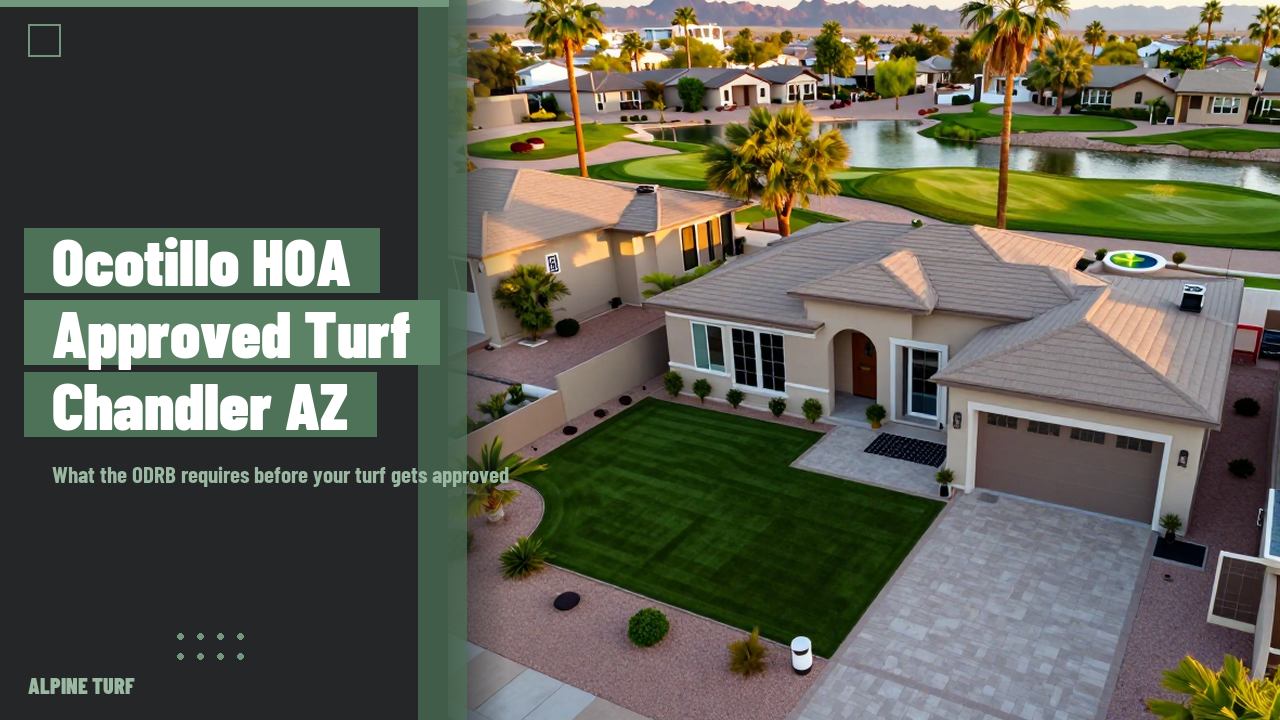
Ocotillo HOA Approved Turf Chandler AZ: What the ODRB Actually Requires
The Ocotillo Community Association publishes exact material specs for artificial turf — face weight, pile height, infill, setbacks. Here's what actually clears the ODRB on the first submission.
Search "ocotillo hoa approved turf chandler" and you'll find plenty of installers claiming a "100% approval rate," but almost nobody quoting the actual rule book. Ocotillo isn't a vague, case-by-case HOA. The Ocotillo Community Association publishes a full Design Standards and Community Rules document with exact numbers for face weight, pile height, infill depth, and setbacks — and the ODRB (Ocotillo Design Review Board) will bounce a submittal that misses any of them.
We pulled the current version directly from oca-az.com's own Documents page (revised January 28, 2025) so this post reflects what the ODRB is actually checking against, not generic "check with your HOA" advice. If you live in one of Ocotillo's lakeside or golf-course-adjacent neighborhoods and you're planning a turf conversion, this is the spec sheet.
What the ODRB Actually Requires Before Turf Goes In
Nothing gets installed at Ocotillo without paperwork first. Per the Design Standards, artificial turf "will be allowed on any lot" — Ocotillo doesn't ban it — but it "must be submitted to the ODRB and approved prior to installation." That's a hard stop. Installing first and hoping for a rubber stamp later is how homeowners end up with a Notice of Violation and, in stubborn cases, a legal referral that can force removal at the owner's expense.
The submittal process itself is straightforward on paper: download the Landscape/Architectural Submittal Form from oca-az.com or the management office, attach your plan, and email it to the ODRB (currently routed through the OCA office at 480-939-6070). The Association has up to 30 days after receipt to issue a decision. Once you're approved, the clock starts the other direction — all approved work must be completed within 120 days, or you're expected to go back for another sign-off.
New-construction owners have their own deadline layered on top: front and rear yards visible from neighboring property on View Lots must have landscaping finished within six months of occupancy, with plans submitted no later than four months from close of escrow. If you closed on a new build near the golf course or one of Ocotillo's lakes, that clock is already running.
The 50% Front-Yard Turf Rule, Explained
This is the rule most homeowners get wrong in the other direction — they assume there's a turf cap, like some East Valley HOAs impose. Ocotillo does the opposite. At least 50% of your front yard's "Landscapable Area" must be natural grass or artificial turf. Landscapable Area means whatever isn't covered by the house, driveway, original front sidewalk, or covered patio — measure that in square feet, and half of it needs to be grass, real or synthetic.
A few details that trip people up on this one:
- Natural grass can't be installed directly against common-area or property-line walls. Artificial turf can — but only if there's no sprinkler head anywhere along that stretch. Add irrigation and you need a 3-foot buffer from the wall.
- Rear yards on lake lots have their own version of this rule: landscaping along the lake edge must be natural or artificial turf specifically to control erosion, and it gets cross-referenced against the Association's lake-maintenance rules in Chapter Five.
- Rear yards on View Lots that aren't lakefront are evaluated case-by-case for a "balance of greenery and hardscape" rather than a hard percentage.
The practical upshot: if you're converting a dead or dying front lawn to turf, you're not fighting the HOA to allow grass coverage — you're fighting to make sure you hit the minimum. That's a very different conversation with the ODRB than most Chandler installers are used to having.
Ocotillo HOA Approved Turf Chandler Homeowners Are Searching For — The Exact Spec
Here's the part most turf companies skip because it's inconvenient: Ocotillo's Design Standards spell out a materials spec more detailed than most municipal codes. If your product doesn't hit every line item below, it's a candidate for rejection regardless of how good it looks in a showroom.
The full list, straight from the ODRB's Artificial Turf standards:
- Country of manufacture: turf should be manufactured in the USA; other products meeting the spec below can be submitted for consideration.
- Installer: must be a contractor licensed to install artificial turf in Arizona — not a handyman or landscaper without the credential.
- Seams: must not be visible. This is a visual inspection item, and it's one of the most common reasons a submittal gets kicked back after install photos are reviewed.
- Color: multi-colored face blades with tan thatch. Single-tone "stadium green" product reads as artificial from the street and doesn't meet spec.
- UV protection: face yarn must have UV inhibitors built in, not just a coating.
- Infill: minimum 3 lbs per square foot of clean 30-grit round silica sand — no crumb rubber, no angular sand substitutes.
- End of life: once turf becomes unsightly, discolored, or worn out, it has to be replaced. The ODRB can and does treat neglected turf as an ongoing violation, not a one-time approval.
- Sample: the ODRB can request a physical sample before approving the submittal.
Putting greens get their own line in the same section: they're permitted in rear yards on any lot, but on View Lots they go through the same submittal-and-approval process, case-by-case, as everything else.
Wall, Lake, and Shoreline Setbacks You Can't Skip
Beyond the material spec, placement matters. Turf can run flush to your side and rear property walls with zero gap — as long as there's no sprinkler head anywhere in that run. The moment you add irrigation along a wall, the rule flips to a mandatory 3-foot setback, sprinklers included.
Trees factor in here too, since most turf conversions also touch the planting plan. Non-custom lots need at least two 24-inch box trees in the front and rear yard (three for custom and semi-custom lots), and anything on a lake lot has to be non-deciduous, set back a minimum of 15 feet from the shoreline and 4 feet from the property line — the Association doesn't want leaf litter and blossoms fouling the lake system. Citrus trees are barred from front yards entirely, and desert landscape material — cacti, Palo Verde, the usual xeriscape palette — isn't approved for areas visible from neighboring property unless it's specifically on Ocotillo's own Landscape Palette list.
One more placement detail that catches new-build owners off guard: if you're planning a driveway expansion alongside your turf conversion, the ODRB will only approve it if 50% turf coverage still holds after the change, and expansions are capped at 24 inches per side, matching material and color to the existing driveway.
What Happens If You Skip the Submittal
Ocotillo enforces this. Members who install landscaping, modify a driveway, or otherwise alter their lot without ODRB approval get a Notice of Violation. If it isn't resolved, the Design Standards give the Association the option to hand the matter to its legal representative — which can end in the unapproved work being removed at the homeowner's own expense. That's a materially different risk than the polite "please submit a form" language some East Valley HOAs use.
The Association backs up several of its landscape and lake rules with specific dollar fines: up to $1,000 per occurrence for dumping landscape debris, grass clippings, or runoff into the lake system, and up to $5,000 for a reclaimed-water cross-connection violation. Turf conversions that disturb irrigation lines near a lake lot need to be planned carefully for exactly this reason.
Natural Grass's Hidden Cost: The Winter Rye Rule
If you're weighing "just keep the natural grass" against converting to turf, know what natural grass actually obligates you to at Ocotillo. Every member with natural turf has to overseed their front lawn with winter rye by October 31st, established by November 15th of the same year — Bermuda goes dormant and brown in the winter, and the Association doesn't allow that look. Miss it, and it's a $500 fine per membership. Homeowners along the golf course, lakes, or otherwise visible from neighboring property have to overseed both front and rear yards.
That's a real annual cost and a real annual task — seed, water, mow through a second growing season, then start over again the following fall. Artificial turf sidesteps the winter-rye requirement entirely, since it's evaluated on the same appearance standard (attractive, weed-free) but doesn't go dormant or brown. For homeowners already tired of the reseed cycle, that's often the actual tipping point, more than the water bill.
How Alpine Turf Gets Your Submittal Approved on the First Pass
Alpine Turf isn't a turf-only outfit — we're a full East Valley landscape installer, which matters here because Ocotillo's rules don't stop at the turf itself. Border material between turf and granite areas has to be concrete, decorative pavers, or brick (flagstone gets case-by-case review); granite has to be one of ten approved screened colors unless you submit for something else; trees have to come off the approved Landscape Palette or get individually justified. A turf-only installer hands you a lawn and leaves you to sort out the rest of the submittal yourself.
We build the ODRB submittal package as part of the quote: turf spec sheet matched line-for-line against the Design Standards (face weight, pile height, infill, warranty documentation), a site plan showing wall setbacks and irrigation placement, paver or masonry border details, and tree selections pulled from Ocotillo's own approved list when the project touches the planting plan. That's the difference between a submittal that clears in one round and one that comes back with questions 25 days into the 30-day review window.
Projects at Ocotillo range from a straightforward front-yard turf swap to a full backyard rebuild with pavers, lighting, and irrigation — scope and pricing follow the same range we see across Chandler backyards generally, from smaller refresh jobs up through custom outdoor living builds on larger lake and golf-course lots. Whatever the scope, the ODRB paperwork gets handled as part of the project, not billed as an afterthought. If your turf conversion is water-conservation driven rather than just aesthetic, it's also worth checking whether you qualify for Chandler's grass removal rebate before you submit — the city money and the ODRB approval are two separate processes, but there's no reason not to stack both.
Frequently Asked Questions
Does Ocotillo allow artificial turf at all?
Yes. The Design Standards state artificial turf "will be allowed on any lot," and Arizona's HB2131 (signed 2022) prohibits HOAs that allow natural grass from banning turf conversions outright. What Ocotillo controls is the appearance and material spec — face weight, pile height, infill, seams — not whether you're allowed to install it.
Do I need ODRB approval for a small turf patch, or just full-yard conversions?
Any installation of artificial turf needs to be submitted and approved before work begins, regardless of size. Interior-lot owners whose rear yards aren't visible from neighboring property have somewhat looser rear-yard submittal requirements, but front yards and anything visible from a neighbor, common area, or the lake always require prior written approval.
Can turf touch my property line wall?
Yes, as long as there's no sprinkler installed along that section of wall. If irrigation is present, the turf needs a minimum 3-foot setback from the wall. This is one of the more overlooked lines in the spec and a common reason plans get sent back for revision.
How long does ODRB review take, and how long do I have to finish the work?
The Association has up to 30 days after receiving a complete submittal to issue a decision. Once approved, you have 120 days from the approval date to complete the work, unless the ODRB grants an extension.
What happens if I already installed turf without approval?
You'll typically receive a Notice of Violation and be asked to submit for retroactive approval. If the installed turf doesn't meet spec, or the matter goes unresolved, the Design Standards allow the Association to escalate to its legal representative, which can result in removal of the unapproved work at the homeowner's expense.
Does Alpine Turf handle the ODRB paperwork for us?
Yes. We build the submittal package — spec sheet, site plan, border and planting details — as part of the quote for any Ocotillo project, matched against the current Design Standards so the submission clears in one round instead of bouncing back for revisions.
Ready for Ocotillo HOA approved turf?
We handle the ODRB submittal as part of the quote — spec sheet, site plan, and border details matched to Ocotillo's Design Standards. Free on-site measure across Chandler and the East Valley.
Book your free quote →